Specialized Telemedicine Mobile App Development

telemedicine mobile appTelemedicine mobile app development requires unique knowledge and expertise in several areas of the software process. Some key components of healthcare mobile app development are HIPAA and HiTrust compliance, software testing, and quality assurance. Any telehealth mobile app will need to be able to connect a patient with the right doctor via video, audio, pictures, and chat. This requires a good understanding of real-time video and HIPAA compliant chat, pictures, and mobile voice calls.


Good telemedicine apps should also have high uptime while ensuring that data is secure to ensure compliance.


Sunvera Software is a leading healthcare mobile app development company positioned to be your best partner for telemedicine mobile app development with the most advanced and HIPAA compliant technology stack and expertise. We can turn around your custom mobile app into reality in a short time and within your budget.


The development of a telemedicine mobile app is not an easy task. The developers must have knowledge in several areas, including healthcare, mobile apps, compliance, and testing. They must also be able to work with other companies who are providing software services for the project.


Telemedicine is an emerging field in healthcare where patients can receive medical care remotely via any form of telecommunications. This includes video conferencing, telephone, and mobile applications. Telemedicine has many benefits for both providers and patients, including increased access to care in rural areas or outside the office hours of a clinic; reduced cost due to fewer visits; more efficient use of time by providers; and lower rates of missed diagnosis. However, telemedicine apps are not exempt from security risks that plague other types of software development projects (e.g., cyberattacks) which means they must be developed with compliance standards such as HIPAA and HiTrust in mind!


The healthcare industry is undergoing a dramatic transformation. New legislation, improved technology, and changing demographics are just some of the factors that have created this shift in the marketplace. And, with telemedicine on the rise, there has been an increased need for specialized telemedicine mobile app development services.


A telemedicine mobile app can be developed to provide a secure and convenient way for patients to interact with their healthcare providers. The benefits of such an app include the ability to remotely diagnose illnesses, access medical records, schedule appointments, and submit insurance claims.


Sunvera Software develops next-level software applications from start-to-finish. We are a premier software and mobile app development agency specializing in healthcare mobile app development, custom mobile app development company, telehealth software, sales dashboards, custom mobile app development services, retail software development, supply-chain software, ecommerce, shopify, web design, iBeacon apps, security solutions and unified access software.

We are proud partners with Amazon AWS, Microsoft Azure and Google Cloud.

Schedule a free 30-minute call with us to discuss your business, or you can give us a call at (949) 284-6300.

Sales Dashboards are Crucial for Sales Teams in These 5 Ways

sales dashboardAs a sales manager, you want your sales people to be focused on the right things. You know that their success depends upon close collaboration with marketing, but it’s hard to see what’s happening all day long. That’s why business intelligence dashboards exist—to bring all relevant information together—so you can make informed decisions and prioritize what needs to get done.

 

5 Ways Sales Dashboards Can Help Your Sales Team Sell More

Sales dashboards provide the right information at the right time to sales teams so they can make better decisions about their activities, prioritizing their time and closing deals.


#1: Identify Trends and Develop Action Plans

The best sales teams are proactive. They recognize which strategies aren’t working and adjust them to make better progress. A good sales dashboard provides the insight necessary to recognize which actions need to be changed or eliminated, such as:

– Leads who don’t respond after multiple attempts

– Customers who cancel the contract right before renewal

– Sales people who don’t meet their quotas

– Sales processes that don’t align with the buyer’s journey

By learning from and adjusting to trends, sales teams can learn how to close more deals.


#2: Motivate with Competition and Collaboration

The most effective sales organizations use competition and collaboration as a way to motivate employees. A good sales dashboard enables managers to set up contests, make comparisons, and track productivity. For instance, managers can

– Recognize top performers by sharing their stats at the company meeting.

– Recognize high achievers in the sales department with an award for reaching certain milestones.

– Invite employees to compare company metrics such as revenue growth per employee.

– Share a leaderboard of employee sales stats with the entire company.

– Highlight employees who have had a high number of customer interactions.

By motivating with competition and collaboration, managers can help their teams capitalize on new opportunities for improved sales.


#3: Improve Sales Performance by Analyzing Activity Data

Sales people spend most of their time interacting with customers. Tracking and analyzing this data helps managers understand how sales people are performing in real time, giving them the opportunity to help before deals fall apart. A good sales dashboard provides:

– An at-a-glance overview of business activity: who’s talking to whom about what and when.

– Alerts that notify managers when a sales person has been inactive for too long.

– Real-time access to call data and notes from interactions, allowing them to coach reps in the moment.

– A record of each interaction a salesperson has with a customer, showing details such as how many emails they’ve exchanged or calls they’ve had.

By understanding how reps are interacting with their customers, managers can provide guidance to help them perform better.


#4: Meet Sales Goals by Tracking Activity and Pipeline Management

For sales teams, it’s all about managing the pipeline—tracking new deals as they open up, monitoring which deals are falling apart, and ensuring that opportunities are moving forward without any hiccups. A dashboard makes the process of managing a pipeline smoother by providing:

– A bird’s eye view of all open deals, including which stage they’re in, whether an email has been sent with any requests for information or quotes, and what the next step is.

– An overview of each salesperson’s pipeline, showing new opportunities and closed deals.

– In-depth information about each opportunity, including details such as the company name and contact person, budget size, and other important metrics.

By tracking activity and pipeline management in real time, managers can provide guidance to help their reps move opportunities forward.


#5: Create a Personalized Customer Experience

Personalization is key to making a lasting impression on customers and building a relationship with them. A good dashboard provides the data necessary to make a personalized experience for each customer:

– Access to a complete list of every customer, their buying habits, and what they’ve recently bought from the company.

– Tracking that shows how many times an individual sales person has interacted with a particular customer.

– Access to historical notes so salespeople can remember details about their interactions with each person.

By creating a helpful and personalized experience, sales teams will make lasting connections with customers.


Other Ways Managers Can Benefit From Sales Dashboards

– Monitoring employee sentiment to detect opportunities for cross-selling and upselling.

– Gathering customer feedback, either through interviews or surveys, so they can gain insight into what is frustrating their customers.

With a holistic perspective on company activity, managers have the opportunity to understand where there are opportunities to improve.

To summarize, sales dashboards give managers a unique window into the actions of their sales people and customers, providing a bird’s-eye view on important metrics.


Sunvera Software develops next-level software applications from start-to-finish. We are a premier software and mobile app development agency specializing in healthcare mobile app development, custom mobile app development company, telehealth software, sales dashboards, custom mobile app development services, retail software development, supply-chain software, ecommerce, shopify, web design, iBeacon apps, security solutions and unified access software.

We are proud partners with Amazon AWS, Microsoft Azure and Google Cloud.

Schedule a free 30-minute call with us to discuss your business, or you can give us a call at (949) 284-6300.

HIPAA Compliant Mobile Apps for Data Security

HIPAAMobile health data security is important now more than ever, as the rate of mobile healthcare continues to increase. With so many different types of devices being used for healthcare, it becomes difficult to keep your HIPAA compliance status.

What’s even harder these days is getting a mobile app built that adheres to HIPAA guidelines, and does not compromise the security of your data.

So what makes a mobile app HIPAA compliant?


Strong device security: To protect users from hackers and identity theft. This means utilizing strong passwords, encryption, and both iOS and Android OS features for maximum security on every device that accesses the app.

Limit who has access to patient health information: This can be done by using role-based security, and only giving the appropriate staff access.

Protecting the integrity of your data: This means backing up information, but not storing it anywhere where unauthorized users can access it.

Ensuring patient privacy: If a mobile device is lost or stolen, you must have plans in place to ensure that there are no breaches in privacy.


If you’re looking for a mobile app to meet HIPAA guidelines you need to look at security first. In order for your data to be secure, everything from the device, network infrastructure, and even staff must be HIPAA compliant. If not, any data that’s collected by your app could be jeopardized in a number of ways.


Sunvera Software develops next-level software applications from start-to-finish. We are a premier software and mobile app development agency specializing in healthcare mobile app development, custom mobile app development company, telehealth software, sales dashboards, custom mobile app development services, retail software development, supply-chain software, ecommerce, shopify, web design, iBeacon apps, security solutions and unified access software.

We are proud partners with Amazon AWS, Microsoft Azure and Google Cloud.

Schedule a free 30-minute call with us to discuss your business, or you can give us a call at (949) 284-6300.

What is Telemedicine Software?

telemedicine softwareThe healthcare industry has seen a large number of advancements in the field of medicine, including telemedicine software. New medical devices and equipment are being invented every day, but one problem that plagues all medical professionals is how to use them effectively. It can be difficult to determine whether or not these devices work because current methods involve experimentally testing these new inventions on animals or small groups of humans.

This process can take years to determine whether or not the device works, and if it does work, how well it actually works. However, with the creation of telemedicine software, new medical equipment can be tested on a wider range of patients and over longer periods of time than ever before. Telemedicine’s ability to help doctors diagnose, monitor treatments, and manage patient information in real time has exponentially increased the industry’s capabilities in every field.


What is Telemedicine?

Telemedicine is the use of telecommunications to provide medical care, remote patient monitoring, education, and consultation. It uses real-time audio and video via computer, telephone, mobile phone technology, or other devices to allow healthcare professionals to have face-to-face interaction with patients from a distance.

One example of telemedicine software in use today is elderly care. Many times, the elderly struggle to get themselves to a doctor’s office for routine visits or follow-up appointments. Telemedicine offers an alternative solution that benefits both the patient and the medical professional. With telemedicine, doctors are able to monitor their patients’ health more closely in order to prevent sicknesses from becoming worse before they have the chance to come in for a visit. The elderly are able to avoid the difficult task of traveling long distances just to see their doctor, and medical expenses are reduced because telemedicine visits are typically much cheaper.

Another example of telemedicine software is with psychiatric care. Telepsychiatry enables psychiatrists, psychologists, counselors, and other mental health professionals to assess and treat their patients remotely. This grants patients easy access to psychiatric care that might not otherwise be available to them due to the professional’s location or time constraints.

There are countless benefits of telemedicine software in use today, but what makes this software so effective? The answer lies in the benefits of telemedicine, which include:

• More awareness, accessibility and affordability for patients

• Improved patient outcomes through real-time care coordination

• Effectiveness at reducing costs while increasing productivity

• Minimizing appointment disparities by providing accessible services to everyone in need. Telemedicine software has revolutionized the healthcare industry, as it is capable of accomplishing things that were never before possible.


Yes, Telemedicine Existed Before the Pandemic Too

The healthcare industry has seen many changes in the past few years. The availability of telemedicine software has become more mainstream, but this is not newer technology. Telemedicine dates back to the late 1990s when the internet became more widespread. Since then, many telemedicine services have been developed that are now available to everyone.

The COVID-19 pandemic further pushed the industry to improve telemedicine software in order to accommodate for doctors who could not make it into work due to quarantine. The result was a major technological advancement that improved telemedicine capabilities through more real-time communication, dynamic clinics, and on-the-go medical devices. As seen with COVID-19, the potential of telemedicine is endless.

However, there are still many challenges that telemedicine has yet to overcome. For one thing, not all hospitals have the necessary technology in place to support telemedicine software. They may lack the infrastructure, technological expertise or financial capabilities to adopt this solution.

Additionally, there are still many people who view telemedicine as a novelty rather than an integral part of patient care. Because the concept is not yet widely accepted, it finds itself competing with more traditional forms of medicine instead of being an alternative to them.

As telemedicine software becomes more prevalent around the world, it is likely that this perception will change. In fact, there is a growing movement in healthcare to make telemedicine a non-negotiable component of patient care. This transition may be slow going, but it’s already happening today in some parts of the world.


The Ever-So-Changing Healthcare Industry

We live in an era of rapid technological growth and development, so it’s only natural that the healthcare industry would be one of the first to feel its effects. In fact, technology has already changed many aspects of patient care, including how we take care of ourselves at home.

While telemedicine software is certainly a factor in this transformation, it is not the only solution that healthcare providers are turning to. For instance, there are several companies (such as Heal) who are implementing their own proprietary services to help hospitals improve the patient experience. Since digital health is becoming more mainstream, many other organizations are taking advantage of these advancements in order to provide faster and more efficient forms of care.

For example, Doctors Without Borders has already expanded its telemedicine efforts across the globe. This organization now provides resources to more than 150 countries through an online portal that many people can access with just a computer or smartphone.

Thanks to doctors who are able to utilize telemedicine software, they are empowered to provide better care around the world. With more medical professionals adopting this strategy, it is likely that we will see a continued increase in remote patient care for years to come.


Where Telemedicine Will Be in Five Years

As telemedicine software becomes more common, it is likely that its rate of adoption will only increase. In addition to this, the technology will become faster and more user-friendly.

Not only does this technology help people better manage their health, but it also gives physicians and other medical professionals more tools to conduct patient care remotely. In fact, many medical schools are now implementing telemedicine software into their curriculums . Someday soon, doctors may not need any other resources to provide the type of care that they would have once needed a physical office for.

As these changes continue to take place, we will most lik see a significant boost in the number of people who have access to this type of care . In fact, a recent study suggested that the healthcare industry would be able to cut costs by up to $56 billion annually if it utilized telemedicine software more frequently.

Thanks in large part to exponential advances in technology, telemedicine is changing how we provide patient care. By making medical treatment accessible to more people around the world, it simultaneously brings healthcare into the digital age. For this reason, telemedicine software is quickly becoming one of the most important tools in medicine today.


Sunvera Software develops next-level software applications from start-to-finish. We are a premier software and mobile app development agency specializing in healthcare mobile app development, custom mobile app development company, telehealth software, sales dashboards, custom mobile app development services, retail software development, supply-chain software, ecommerce, shopify, web design, iBeacon apps, security solutions and unified access software.

We are proud partners with Amazon AWS, Microsoft Azure and Google Cloud.

Schedule a free 30-minute call with us to discuss your business, or you can give us a call at (949) 284-6300.

Healthcare App Development: 8 Hot Healthcare App Ideas Right Now

healthcare appThe healthcare industry is one that has always been popular in creating apps. There are countless applications that have come out, but the problem is that many aren’t useful enough to make it on a list of “must-have” apps. Take a look at our list below for some good ideas for your next app!

 

1. Medical Transcription Management System

This is a web-based application that will allow you to monitor the patient’s progress, check for medication allergies and previous procedures, and edit/approve reports submitted by your transcription services. The ability to streamline the backend reporting for your office is priceless.


2. Homecare Tracking Tool

Hospitals are currently moving towards an era of ‘Homecare’ where patients suffering from chronic conditions are encouraged to manage their own care as much as possible. This app will help them monitor vital signs, pharmacological intake and progress etc.


3. Patient Information System

Imagine a tablet application for doctors and nurses that gives them up-to-date information about their patients. This app will help speed up the process of patient treatment by removing any barrier between information and those who require it.


4. Hospital Patient Flow Tool

Clinicians working in government hospitals are often faced with manpower shortages. An application that will help visualize the number of patients visiting a physician on any given day/shift and the time taken to treat them will go a long way in increasing the productivity of healthcare personnel.


5. Healthcare Mapping Tool

Medical mapping tools help physicians/clinicians visualize medical data over maps based on clinical, epidemiological and demographic information of relevant populations. They are particularly beneficial for administering flu-shots to specific regions with optimum efficiency.​


6. Hospital Ward Management Tool

A hospital ward management tool helps the medical manager understand how efficiently a ward is being utilized and thus, take corrective measures that will help improve the situation. Additionally, it helps increase hospital revenue by finding more efficient staffing levels and room utilization.


7. Disease Management Application

A disease management app helps sufferers of chronic illnesses such as diabetes and high blood pressure monitor their symptoms and keep track of their medication. Physicians can also monitor the progress of their patients remotely.


8. Telehealthcare Mobile Application

This mobile application helps connect doctors with healthcare specialists across specialties in real-time. Patients suffering from chronic illnesses can access the app, locate a specialist in their area, and book an appointment with them.


Healthcare app development is a rapidly growing industry, and offers great prospects for entrepreneurs. With the increasing number of smartphones in the market, mobile health-care apps are in high demand to help providers deliver healthcare services at any time, anywhere.


Sunvera Software develops next-level software applications from start-to-finish. We are a premier software and mobile app development agency specializing in healthcare mobile app development, custom mobile app development company, telehealth software, sales dashboards, custom mobile app development services, retail software development, supply-chain software, ecommerce, shopify, web design, iBeacon apps, security solutions and unified access software.

We are proud partners with Amazon AWS, Microsoft Azure and Google Cloud.

Schedule a free 30-minute call with us to discuss your business, or you can give us a call at (949) 284-6300.

5 Trends in Automotive Software Development

automotive softwareIt’s no secret that car manufacturers are still catching up with the software industry. It seems like every day another manufacturer announces their collaboration with a automotive software company to produce connected, self-driving cars.

Car manufacturers may be struggling to keep up with this shift, but perhaps it is time they don’t have to battle alone. They should look to the software industry for insight on how to move forward.

Here are five trends that could help car manufacturers future-proof themselves and get more value from the software they produce.


1. Think Like a Startup

Car manufacturers are some of the biggest companies in the world, but they have failed to adopt an entrepreneurial mindset when approaching software development.

Startups work on tight budgets and short deadlines, so they need to innovate quickly. This has taught them how to prioritize before spending time on something unimportant. Startups also understand the importance of open communication about software development.

Car manufacturers need more adaptability. As their products become more connected, they will be responsible for more aspects of the software that runs them. If something goes wrong, or if users want an extra feature, car manufacturers must be able to accommodate requests quickly. A startup mindset can help them achieve this by prioritizing what’s important and having the flexibility to change direction when needed.


2. Follow Industry Standards

Car manufacturers should follow industry standards for their software development. They need to seek feedback from their customers and iterate on what they learn to produce better products in less time. This doesn’t just apply to car manufacturers either – every company should be following industry standards while accelerating their software development.

Industry standards can help car companies produce better products more efficiently. If every company agrees on the technology to use, they will save time by not having to develop it themselves or figure out how another company’s product works. A standard increases compatibility between different types of cars and enables manufacturers to produce more innovative products in less time.


3. Outsource When Possible

Outsourcing is often viewed as an easy way for corporations to cut costs, but it has become increasingly popular with startups because of its benefits for the speed and quality of their software development.

When a startup starts outsourcing some of its software development, most employees are still working on developing new features while only a few focus on supporting the outsourced work that’s already live. This ensures that the startup has more time to dedicate to developing new, innovative products while making sure its current product is still up-to-date.

Automobile manufacturers should consider this strategy when developing their software. Outsourced work could include updates for existing features or smaller requests submitted by users instead of large, long-term projects like building self-driving cars.


4. Treat Software Like a Product

Every company should treat software like a product because it provides opportunities for users to contribute and gives value back to companies if they can better serve their users’ needs. Automobile manufacturers need the flexibility of a startup in order to incorporate changes based on customer feedback such as waiting until after an initial release before building major features so that they can prioritize implementing smaller requests from customers instead.


5. Focus On the Customer Experience

The thing that makes automotive software development different from other industries is that your target market isn’t just people who use your physical product; you must consider anyone who interacts with your digital products and how it affects their experience.

Car manufacturers need to prioritize their customers’ needs in software development the same way they do in automotive production. They should always focus on how users will interact with what they’re building and ensuring that the user experience is as seamless as possible, even when things go wrong.

This ensures that users remain satisfied with whatever you develop whether it’s an update for existing features or a new product. Automobile manufacturers could incorporate this mindset into their software development by prioritizing usability over features.

Car companies need to develop relationships with their customers, but at the same time, they need to be open about what they’re trying and willing to change when customers give feedback.


Sunvera Software develops next-level software applications from start-to-finish. We are a premier software and mobile app development agency specializing in healthcare mobile app development, custom mobile app development company, telehealth software, sales dashboards, custom mobile app development services, retail software development, supply-chain software, ecommerce, shopify, web design, iBeacon apps, security solutions and unified access software.

We are proud partners with Amazon AWS, Microsoft Azure and Google Cloud.

Schedule a free 30-minute call with us to discuss your business, or you can give us a call at (949) 284-6300.

Benefits of a Custom Mobile App Development Company

custom mobile app development companyIn this day and age, it is important to know how to use technology in order to survive in business. Custom mobile app development has gained popularity in the past few years and so much so that we can no longer ignore its importance if we want to progress in our respective careers. One smart move could be partnering with a custom mobile app development company in order to come up with a tailored mobile application that will help your business excel.

 

Why Customization Should Be a Key Factor For Your Mobile App Development

The responsible thing to do is to study your target audience and come up with custom mobile app development strategy that will appeal to them. If you are the owner of a popular children’s clothing line, for example, it would be wise to create a mobile application that will cater exclusively to families with kids. Creating an app specific to such an audience will give you the opportunity to tap into a whole new market of potential customers.

Your mobile app should be based on solid design principles which will, hopefully, help you achieve your desired business objectives. This would require consulting with creative minds who are well-versed in the field of custom mobile app development. A good design takes into consideration the user interface as well as information architecture of your mobile app.

In light of the increasing number of apps that are now available on both Apple Store and Google Play, it is important to differentiate your business’s offering from that of competitors’. Your target market should have a fairly good idea of what they want – it is up to you to give them what they are looking for.


Why Partnering With a Custom Mobile App Development Company Proves to Be a Good Choice

Here are some compelling reasons why you should partner with a custom mobile app development company:


1)  More Mobile Users Than Ever Before

According to reports by Statista, there are more than 2.56 billion smartphone users across the world, which is a significant increase from 2.24 billion users in 2016. In the US alone, 77% of people rely on smartphones to surf the internet and more than half of them make online purchases by mobile devices. This offers more lucrative opportunities for entrepreneurs who are willing to go the extra mile in order to engage with their customers in this highly competitive market.


2)  A Widely Available Resource

There are numerous custom mobile app development companies that you can partner with in order to create a solid user experience for your potential customers. You can easily find developers who are proficient in various technical disciplines including UX design, UI design, database administration, web development and project management.


3)  High Return On Investment

A high return on investment means that you are able to get more out of each dollar you spend by creating an app that will go beyond satisfying customers’ expectations. According to reports, mobile apps pay for themselves within an astounding two months.


4)  Developing a Strong Brand Presence

Mobile apps that are well-designed and easy to use will pave the way for future success for your business. You can opt to create a mobile application that will serve as a direct link between you and your customers, and one that will help you establish and strengthen your brand reputation.


How to Choose the Right Mobile App Development Company

The right mobile app development company will be able to help you maximize the ROI of your business. It is up to you to do a thorough background check on potential candidates in order to determine whether or not they have the experience and expertise to make your vision a reality. Here’s how:

  • Check out websites online for reviews from previous clients in order to determine whether or not they are capable of meeting your expectations.
  • Identify what sets them apart from their competitors, if any. If they provide the same services as other companies, you should consider partnering with them only if they offer exclusive features that will help to see growth.
  • Do some research on the team behind the company’s success. You must ensure that they have a track record of successful projects and that their previous clients are satisfied with the end product.
  • Before you partner with them, make sure to identify your needs first. It is important to have a clear picture of where you currently stand and what it is that you are looking for.

Every entrepreneur is trying to do their part in order to make their business stand out from the rest of the pack. With so many custom mobile app development companies around, it’s up to you to determine which ones are the best fit for your business. It would be in your best interests to partner with a company that is capable of producing excellent results in order to gain higher visibility in the market and in turn, increase sales conversions.


Sunvera Software develops next-level software applications from start-to-finish. We are a premier software and mobile app development agency specializing in healthcare mobile app development, custom mobile app development company, telehealth software, sales dashboards, custom mobile app development services, retail software development, supply-chain software, ecommerce, shopify, web design, iBeacon apps, security solutions and unified access software.

We are proud partners with Amazon AWS, Microsoft Azure and Google Cloud.

Schedule a free 30-minute call with us to discuss your business, or you can give us a call at (949) 284-6300.

Sunvera Software Obtains Another 5-Star Rating on Clutch

More and more people are relying on Sunvera’s mobile devices for various purposes. From productivity to entertainment, mobile applications cater to almost every digital need of billions of users worldwide. Developers also continue to discover new implementations to improve the apps they build. At Sunvera Software, we’re all about the progression of technology and how we can utilize such advancements to the solutions we offer.


Since 2013, our team has been helping clients build one-of-a-kind digital experiences. We believe that every idea can be brought to life with creativity and innovation. Thus, we aid businesses of all sizes to realize their vision. Sunvera’s expertise provides cost-effectiveness and secure development. Whether it’s a mobile app, a website, or enterprise software, we can make it happen!


As we strengthen our relationships with our partners, we’ve recently acquired another feedback through the Clutch platform

Clutch

First time hearing about Clutch? To explain, it is a B2B ratings and reviews platform based in Washington, DC. They evaluate technology service and solutions companies based on the quality of work, thought leadership, and client reviews. 


A rapidly expanding startup, Clutch has become the go-to resource in the agency space. Their review process is reliable and transparent, and we’re grateful to those of our clients who have taken the time to provide feedback.


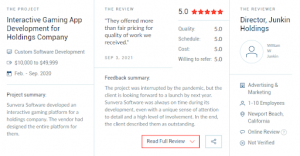
Our newest review comes from Junkin Holdings’ Director, William Junkin. His talk with the Clutch team gave insight into what transpired during their partnership with Sunvera. He discussed the main challenges that they were facing, and why Sunvera’s services were impactful to their business.


“The development of a new interactive gaming platform — They [Sunvera] designed the entire platform we needed.

Their attention to detail, follow-up, and level of involvement was outstanding.”


— William Junkin, Director at Junkin Holdings


While the launch of the product was delayed due to the pandemic, the client is looking forward to releasing it next year. We’d like to express our appreciation to Junkin Holdings for taking the time to leave a positive review, and we can’t wait to see their upcoming success in launching the app.


Find out more about Sunvera Software’s accomplishments on our Clutch profile. We’re also ranked highly on Top Design Firms, a brand new B2B resource.


We’d love to know more about your ideas. Send us your inquiry now, and we’ll get back to you right away!


Sunvera Software develops next-level software applications from start-to-finish. We are a premier software and mobile app development agency specializing in healthcare mobile app development, custom mobile app development company, telehealth software, sales dashboards, custom mobile app development services, retail software development, supply-chain software, ecommerce, shopify, web design, iBeacon apps, security solutions and unified access software.

We are proud partners with Amazon AWS, Microsoft Azure and Google Cloud.

Schedule a free 30-minute call with us to discuss your business, or you can give us a call at (949) 284-6300.

Common Errors in Custom Mobile Application Development

custom mobile application developmentCustom application development is a complicated process and requires both in-depth knowledge of application programming and mobile platforms. In contrast to common belief, reliable development of a custom mobile app takes longer than expected. In order to meet the expectations of your clients and deliver great results, you should be aware of most frequent mistakes that affect project success.

 

Custom Mobile Application Development: Common Mistakes to Avoid

Here are some common mistakes to avoid is custom mobile application development:


1. Not Understanding the Target Audience of Your App

Targeting the wrong audience is a common mistake that leads to decreased sales and less positive reviews. Before you start custom mobile application development , make sure to identify specific target users and their preferences. When you know what type of people will be using your product, you can adjust features of your app to match their needs and preferences.


2. Forgetting About Android Version Fragmentation

The majority of Android devices are capable of running an application developed for most recent operating system release without any significant issues. However, there is a drawback associated with this fact: since there are so many models and each one differs from the other, you need to create a separate app for each device. Before you start custom mobile application development, be aware of the risk related to Android version fragmentation and work out a plan that will deal with this issue.


3. Taking On Too Many Projects at Once

Having too many projects at the same time can make it difficult to meet all goals and deadlines. It is almost impossible to provide high-quality work in such circumstances and maintain proper communication with clients.


4. Not Planning Work Properly

Creating a schedule after you have started working is often not enough – it’s better to plan your tasks before they are assigned to you, particularly since mobile app development is time-consuming and requires attention to detail. When you allocate time for each task and break it down, you can easily determine how much time is needed for your project and avoid missing its due date.


5. Not Analyzing the Competition Properly

Creating an application in a competitive niche means that you should be aware of direct and indirect competitors and keep track of their updates and enhancements to offer better applications than them. If you discover that your potential customers are more interested in another product, you can either adjust your idea or choose a different niche for developing the application.


6. Neglecting UI & UX Design

Design plays an important role in mobile app success, so don’t forget to involve professional designers in your team. You can’t examine all designs by yourself since you don’t have the necessary experience to compare average and best-in-class designs.


7. Choosing an Inappropriate Programming Language

If you are new to the industry, it is better to avoid complicated languages with unique terminologies and instead prefer languages that are more straightforward and easier to learn.


8. Copying Someone Else’s Code

Although it is tempting to use ready-made solutions, they can cause more problems most of the . Remember that if you are not the one who developed the solution, you might encounter serious security issues that are difficult to find and fix on your own. Before using someone else’s code, ensure that it is error-free and up to date. This means you should read the license terms and check if the product you are planning to use is free of licensing or patent restrictions.


9. Not Testing Properly

Testing should be an integral part of any development process because it helps find errors earlier, when they are easier to fix. The longer you wait, the more expensive it will be to fix the mistakes and issues that should have been discovered earlier.


10. Not Using Analytics Properly

Analytics allow you to collect data about how users interact with your application and make decisions based on this information (for example, whether they use particular features or remain on a particular screen for longer than others). If you don’t understand the data provided by analytics, you won’t be able to improve your product and provide better user experience.

Whatever mistakes you make during custom mobile application development, it is vital that you learn from them and avoid repeating them in future projects. It’s also worth considering hiring professional help – it is often more helpful to invest in professional services than to try and do everything on your own.

After you have learned from mistakes made during application development, you should be able to increase the chances of success for future projects. Productivity and profitability go hand-in-hand – as long as you learn from your mistakes, your profits will increase.


Sunvera Software develops next-level software applications from start-to-finish. We are a premier software and mobile app development agency specializing in healthcare mobile app development, custom mobile app development company, telehealth software, sales dashboards, custom mobile app development services, retail software development, supply-chain software, ecommerce, shopify, web design, iBeacon apps, security solutions and unified access software.

We are proud partners with Amazon AWS, Microsoft Azure and Google Cloud.

Schedule a free 30-minute call with us to discuss your business, or you can give us a call at (949) 284-6300.

5 Technology Trends Reshaping Retail in 2021

retailRetail is an industry that has long seen extensive changes. An evolving retail landscape requires retailers to stay ahead of the curve with innovative technology and personalized customer experience. As traditional eCommerce stores, marketplaces and social platforms continue to push the boundaries of retail, there are many technology trends that are expected to rise in importance for retailers. These technologies will have a significant impact on customer experience and business growth. As this landscape is ever-changing, it’s crucial for retailers to stay ahead.


 

A Closer Look at the Top Retail Trends of 2021

There are many trends that are currently changing the face of retail, but here are the top five trends affecting the industry.


1. Edge Computing Will Be Used Across Multiple Devices To Make Shopping Faster and Easier for Customers

It’s not just the big brands that are looking at blockchain to provide a more secure way of managing data. Smaller retailers are also considering how this technology could help their businesses, giving them an edge over competitors. Blockchain provides tamper proof records, meaning that retailers would have a better handle on their data and who they are sharing it with. It’s hoped that this could lead to improvements in the customer experience.


2. Voice Will Be Bigger Than Touch in 2021

Voice-controlled computing is presenting a huge opportunity for brands in a number of sectors, including retail. The technology is already well embedded in devices such as Amazon’s Echo and, according to Capgemini, voice commerce will be the dominant form of digital transaction by 2021.

As we’ve seen with the growth of mobile phones and tablets, consumers are shifting towards touchscreens as their preferred way to interact with devices. If retailers want to get ahead, they need to make sure that their websites and apps are fully responsive, are compatible with voice devices, and are designed to create a seamless shopping experience.


3. Advertising Budgets Will Be Invested in Augmented Reality

Augmented Reality (AR) is the future of online shopping, allowing retailers to give customers an interactive experience that’s more engaging than clicking around on a website. According to Business Insider, the global AR market is expected to be worth a whopping $165 billion by 2021.

Advertising budgets are already being invested in AR, with over 4 out of 5 marketing professionals planning to increase their use of the technology according to a recent survey. Augmented Reality will allow customers to virtually try on clothes and accessories, making sure that they purchase items that fit them perfectly.


4. Retail Apps Will Have the Biggest Consumer Adoption Since Facebook

Even before social media became a household name, retail apps were being developed to help customers get information about products. However, they’ve never been as popular as they are now, with more than half of smartphone owners downloading shopping-related apps to their devices (OuterBox).


5. Data Will Drive Personalized Customer Experiences

As online shopping becomes more and more popular, combined with the power of personalization technology, it’s no surprise that retailers are relying on data more than ever to create personalized experiences for their customers.

With access to so much data about their customers, retailers can get closer to their audiences by creating targeted campaigns and ensuring that the user journey is smooth and pain-free. Customers are more likely to purchase from a retailer they trust, so providing them with all of the relevant information will go a long way towards building this relationship.

As technology continues to change and develop, so will the retail landscape. Retailers should be aware that it’s not just about getting ahead of competitors in their industry, but also trying to keep up with all of the latest advancements happening across every sector. The companies who are able to innovate and use new technologies effectively will find themselves better placed for a competitive advantage in the future.


Sunvera Software develops next-level software applications from start-to-finish. We are a premier software and mobile app development agency specializing in healthcare mobile app development, custom mobile app development company, telehealth software, sales dashboards, custom mobile app development services, retail software development, supply-chain software, ecommerce, shopify, web design, iBeacon apps, security solutions and unified access software.

We are proud partners with Amazon AWS, Microsoft Azure and Google Cloud.

Schedule a free 30-minute call with us to discuss your business, or you can give us a call at (949) 284-6300.