Trendiest News in Tech

How Are Cryptocurrencies Being Used? Here’s 10 Ways Crypto is Changing Various Industries

ways crypto is changing

There are many ways crypto is changing the way companies do business. Cryptocurrencies have been around for a while now, and many people are still trying to figure out what they are and how they work. Cryptocurrencies are digital or virtual tokens that use cryptography to secure their transactions and to control the creation of new units.

Cryptocurrencies first came into existence with Bitcoin in 2009. Bitcoin is a decentralized digital currency that doesn’t rely on a central authority to manage its transactions or to issue new units.

However, Bitcoin is not the only cryptocurrency that exists. There are currently over 1,500 different cryptocurrencies in existence, and more are being created all the time. Cryptocurrencies are being used in a variety of ways, and they are starting to change the way that various industries operate.

Here are 10 cryptocurrency use cases involving various industries:


1. Banking

Of course, this had to be first on the list. Cryptocurrencies are starting to disrupt the banking industry. Banks are no longer the only way to store and transfer money. Cryptocurrencies allow for faster, cheaper, and more secure transactions than traditional banks. In addition, cryptocurrencies are starting to be used as a form of currency. There are now many businesses that accept Bitcoin and other cryptocurrencies as payment. This is slowly but surely starting to take market share away from traditional banks.


2. E-commerce

Cryptocurrencies are also disrupting the e-commerce industry. e-Commerce businesses are no longer limited to accepting traditional forms of payment like credit cards and PayPal. Cryptocurrencies are starting to be used as a form of currency. There are now many businesses that accept Bitcoin and other cryptocurrencies as In addition, cryptocurrencies can be used to purchase goods and services online. This is a huge advantage for merchants, as it allows them to reach a global audience without having to worry about cross-border payments or currency conversions.


3. Travel

The travel industry is another being effected by crypto. There are now many websites that allow you to book flights and hotels with Bitcoin. This is a huge advantage for travelers, as it eliminates the need to carry around extra cash or to worry about currency conversions. There are now a number of travel agencies that accept cryptocurrencies as payment.


4. Healthcare

Healthcare startups are starting to develop platforms that allow patients to pay for their healthcare expenses with cryptocurrencies. This is a huge advantage for patients, as it allows them to avoid paying high transaction fees and to avoid having to provide their personal information. Crypto will also transform the healthcare industry by allowing patients to store their medical records on the blockchain.


5. Charity

Cryptocurrencies are also starting to be used for charity donations. This is a huge advantage for charities, as it allows them to receive donations from all over the world without having to worry about cross-border payments or currency conversions. In addition, cryptocurrencies allow for more transparency and accountability than traditional donation methods.


6. Real Estate

In the real estate world, cryptocurrencies are being used to purchase property. This is a huge advantage for real estate investors, as it eliminates the need to carry around extra cash or to worry about currency conversions. There are now a number of real estate platforms that allow investors to purchase property with cryptocurrencies.


7. Gaming

Out of the many ways crypto is changing industries, the gaming industry has to be included on the list. There are now a number of online gaming platforms that allow gamers to pay for their games and in-game items with Bitcoin and other cryptocurrencies. This is a huge advantage for gamers, as it eliminates the need to carry around extra cash or to worry about currency conversions. Gaming developers benefit from crypto as well, as it allows developers to receive payments for their games and in-game items without having to worry about banking fees or payment processing delays.


8. Journalism

There are now a number of news websites that allow readers to pay for their content with crypto. This is a huge advantage for journalists, as it allows them to receive payments for their work without going through a third-party. In five years, it is likely that most news websites will allow readers to pay for their content with cryptocurrencies.


9. Education

In education, there are now a number of online learning platforms that allow students to pay for their courses with cryptocurrencies. This allows for more flexibility and convenience for students, as they can now study from anywhere in the world without having to worry about exchanging currencies.


10. Art

You must have heard of the term NFTs. It is short for Non-Fungible Tokens. They are tokens which represent unique assets. One of the first use cases for crypto was in the art world. Cryptocurrencies are now being used to purchase art from online galleries. This is a huge advantage for artists, as it allows them to sell their artwork without going through a third-party. In addition, it allows artists to receive payments for their work in a timely manner.


Conclusion

As you can see, there are many ways crypto is changing the business world. Crypto is transforming almost any industry you can think of, by making transactions faster and smoother with minimal effort. This is just the beginning for crypto, and in the next five years, we can expect to see it being used in even more industries. So far, there has been no industry that crypto hasn’t managed to change for the better.

Sunvera Software develops next-level software applications from start-to-finish. We are a premier software and mobile app development agency specializing in healthcare mobile app development, custom mobile app development, telehealth software, sales dashboards, custom mobile app development services, retail software development, supply-chain software, ecommerce, Shopify, web design, iBeacon apps, security solutions and unified access software.

We are proud partners with Amazon AWS, Microsoft Azure and Google Cloud.

Schedule a free 30-minute call with us to discuss your business, or you can give us a call at (949) 284-6300.

If You Operate in these 5 Industries, You need to Optimize Your SEO

SEO

SEO is a complex and ever-changing field. What worked well for your website last year may not be as effective today. That’s why it’s important to stay up to date on the latest trends and practices, and optimize your SEO strategy accordingly. Whether you have previously worked on SEO or you do not know a single thing about it, we are here to help you learn the importance of SEO and who needs it the most.


How To Optimize SEO For Your Website

Before we get into the industries, here are some general tips on optimizing your site’s SEO.

1. Research your keywords.

When it comes to SEO, keywords are still king. Do your research and find the keywords that are most relevant to your business and target them throughout your website.

2. Optimize your titles and meta descriptions.

Make sure your titles and meta descriptions are properly optimized with your target keywords, so you can rank higher in search engine results pages.

3. Optimize your images.

Including keywords in your image file names and adding captions can help you rank higher in search engine results pages for those images.

4. Publish high-quality content.

Google rewards websites that publish high-quality, engaging content with better rankings and more traffic. So make sure you invest in quality content that will keep your visitors coming back for more.

Now that we’ve covered the basics, let’s take a look at some specific industries where SEO optimization is essential.


5 Industries That Rely on Good SEO

Here are 5 industries that have a lot to benefit from with good SEO.

1. E-commerce

E-commerce websites need to be near the top of search engine results pages in order to compete with the large retailers. SEO can help you do just that.

2. Local businesses

Local businesses can benefit from good SEO by appearing higher in local search engine results pages. This can result in more website visitors and more customers.

3. Travel websites

Travel websites need to rank high in search engine results pages in order to attract potential customers. They also need to optimize their website for mobile devices, as more and more people are searching for travel information on their phones and tablets.

4. Medical websites

Medical websites need to be near the top of search engine results pages in order to attract patients. SEO not only helps healthcare companies attract more patients, but also helps them rank higher in Google Maps results.

5. Law firms

Lastly, law firms need to be near the top of search engine results pages in order to attract potential clients.


SEO For Small Businesses

While SEO is important for all businesses, it’s especially important for small businesses. Small businesses often don’t have the budget to invest in traditional advertising, so SEO is a cost-effective way to get your business in front of potential customers. It is important to keep in mind the various SEO strategies that small businesses can apply. These include :

1. Targeting long-tail keywords

2. Optimizing your website for mobile devices

3. Publishing high-quality content

4. Creating a social media presence

5. Participating in online directories

6. Building backlinks

7. Tracking your results

By targeting the right keywords, optimizing your website, publishing high-quality content, and using the other SEO strategies listed above, you can give your small business the boost it needs to compete with larger businesses.


Sunvera Software develops next-level software applications from start-to-finish. We are a premier software and mobile app development agency specializing in healthcare mobile app development, custom mobile app development, telehealth software, sales dashboards, custom mobile app development services, retail software development, supply-chain software, ecommerce, Shopify, web design, iBeacon apps, security solutions and unified access software.

We are proud partners with Amazon AWS, Microsoft Azure and Google Cloud.

Schedule a free 30-minute call with us to discuss your business, or you can give us a call at (949) 284-6300.


How to Create an NFT Minting Platform: A Simple Guide

Would you like to create your NFT minting platform but don’t know where to start?

Creating an NFT minting platform can be a daunting task. In addition to having to navigate the often-confusing crypto terminology and jargon, one also needs to have a good technical understanding and be able to identify potential security risks. With so much changing daily, it can be difficult to keep track of what’s needed to build your perfect NFT minting platform.


What Are NFTs?

Non-fungible tokens (NFTs) are a unique type of cryptographic asset that is quickly gaining popularity due to their many applications and use cases. NFTs are unique in that each token is completely different from any other, making them perfect for representing physical or digital assets. Non-fungible means unique, one of a kind, irreplaceable.

NFTs are built on Blockchain technology. This allows them to be stored securely and traded easily. NFTs can represent anything from digital art and collectibles to in-game items and even physical assets like real estate or cars.


How Do NFTS Work?

Let’s say somebody sells you a piece of digital artwork online. With NFTs, they would also provide you with the ownership rights of the piece. You will now become the official owner of the art piece, though the actual owner can still have rights to copyright and reproduce the piece.


Why Do NFTS Work?

Addressing why NFTs are working well in today’s day and age is just as important as addressing the how piece. The main reason why NFTs are taking off is because they produce digital scarcity, a concept that has been a challenge in the digital world ever since it came about. In other words, only one person can own a single NFT at a time.

Just think about it. How many times have you heard about art being replicated so that there are more and more copies of the same piece being produced, with no indicator as to which one is the original? Millions of digital assets have lost their value because of this, and NFTs are the solution to bring back value to original work.

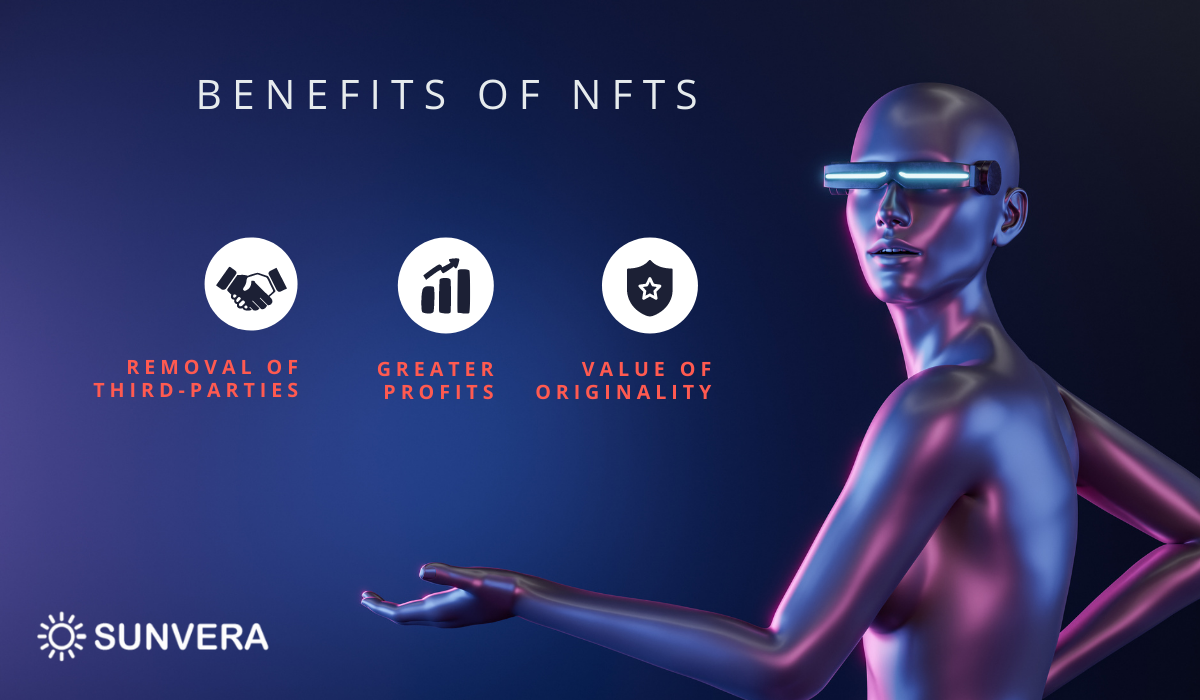
Another reason why NFTs are attractive for many is the ability to eliminate any third-parties between artists and their buyers, whether it is digital art, music, games etc. The absence of a third-party to help make the transaction allows the original artist to keep around 90% of the profits; the other 10% goes to the NFT minting platform being used.

What happens after the original seller sells his or her digital asset? Well, if they choose to add royalties, they can earn a profit from each sale made afterwards. This is a great way to ensure that artists are fairly compensated for their work and that they can continue to generate income from it long after the initial sale.
Benefits of NFTs


Applications of NFTs

Here are some potential applications of NFTs that could be used on your minting platform:


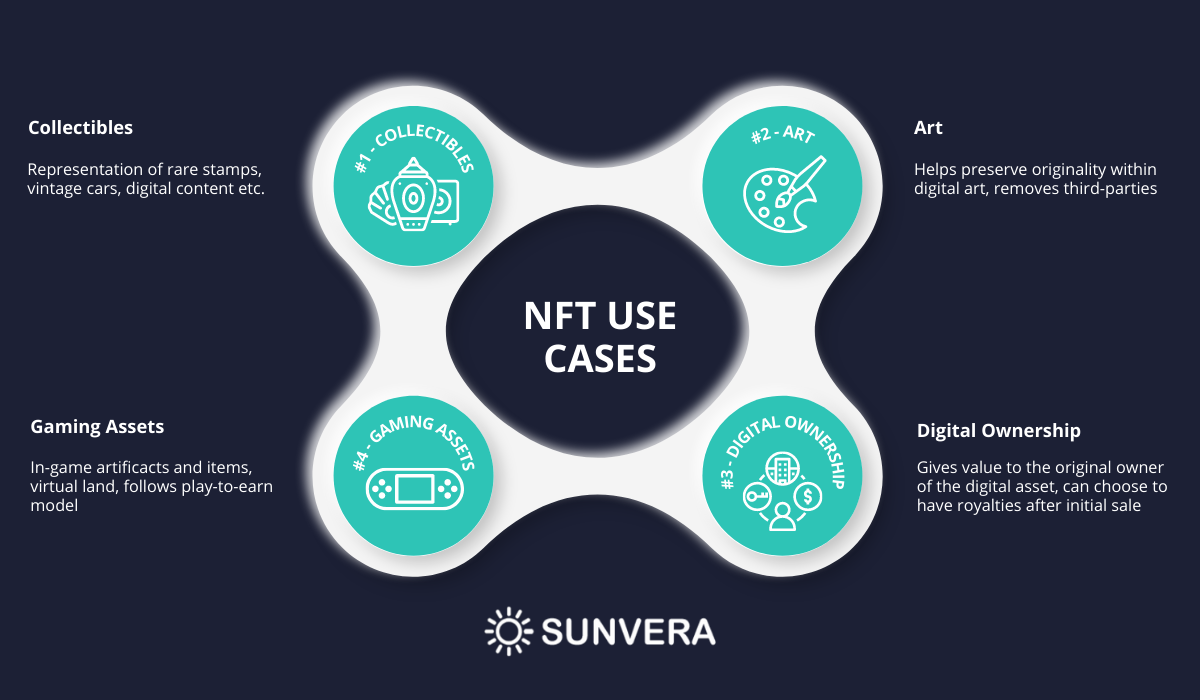
Collectibles

NFTs are especially popular among collectors, as they can be used to represent unique physical or digital items. This could include assets such as rare stamps, vintage cars, or even digital content such as songs or videos.


Gaming Assets

NFTs can also be used to represent in-game artifacts and items. These could be anything from weapons and armor to unique skins or game worlds. You can also buy virtual land within the game. This allows people to engage more with the game, and invest in it, both mentally and physically.

There is a term going around in the gaming world currently, and it’s called ‘play-to-earn’. These games are generally free to download, but you cannot play them without NFTs, which must be bought separately. The play-to-earn model follows the concept of GameFi, where game assets are traded for financial rewards, in this case, crypto. The more crypto you earn, the more NFTs you can purchase to trade and sell within the game.


Digital Ownership

NFTs can be used to represent digital assets and content such as website domains, social media accounts, or even cryptocurrency wallets. As mentioned before, the original owner of a digital asset can continue to gain value from their asset if they choose to add royalties. This is where digital ownership really comes in. The original artist never really loses their connection with the asset, even if they have sold it to somebody else.
NFT use cases


Highest NFT Sales

The most expensive NFT sale to date is $91.8 million, and it is Pak’s ‘The Merge’, sold in December 2021.

Following that one is the $69 million for Beeple’s ‘Everydays: The First 5000 Days’. This piece is a digital collage of sorts, made up of elements from Beeple’s everyday life over the span of 13 years.

Moving away from artwork, other industries are making massive NFT sales. In the music industry, Kings of Leon are sending an NFT to space for charity, where the bidding starts at $50,000.

Virtual property is also going for millions. In November 2021, ‘Decentraland’ sold virtual land for $2.4 million. This is known as the largest metaverse acquisition so far.

NFTs are changing the way we think about digital assets and content, and there is no doubt that we will see more multimillion-dollar sales in the future. With the ability to represent just about anything, it’s not hard to imagine a world where everything is tokenized.


Why Use NFTs (Besides the Profitability Piece)?

Besides digital ownership, there are many reasons why you might want to use NFTs:


Security

NFTs are stored on the blockchain and cannot be tampered with or stolen. This makes them ideal for storing valuable assets. The removal of a third-party also helps increase security, as the sale or trade is made directly within the seller and buyer. Blockchain networks are known for secure data encryption due to operating on a decentralized system. There are many uses of NFTs to enhance security, including using smart contracts, encrypted messaging, and more.


Portability

NFTs can be easily transferred between users, making it easy to trade and sell assets. NFTs are stored in secure wallets, which can be used to make transactions wherever they are. The ability to store these tokens in an online wallet that is both secure and portable makes them a highly attractive option.


Simplification

NFTs possess the power to remove intermediaries and simplify transactions, while making them more secure and less prone to fraud. It’s a win-win situation.


What is NFT Minting?

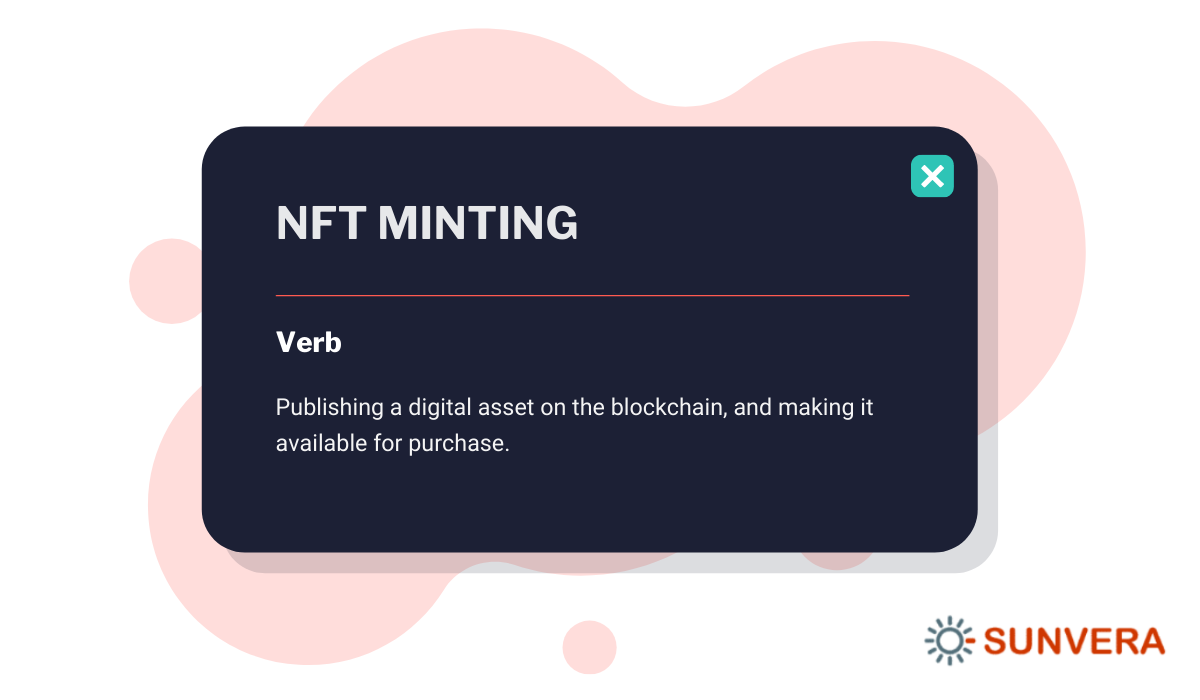
When you ‘mint’ an NFT, you simply publish it on the blockchain and make it available for purchase. In order to do this, you have to first create a digital wallet, purchase some crypto to cover the cost of minting your NFT, and then you can publish it in an NFT Marketplace such as OpenSea or FTX US. Many NFT marketplaces will allow artists to set royalties for better tracking sales after the initial sale has been made. Along with earning more profit, this can be particularly helpful for artists to track demand for a certain digital asset, which can give them ideas on what to create and sell next, so it is a highly recommended practice.

Whether you want to participate in NFT markets by purchasing an NFT or minting an NFT depends on you and how much risk you want to take. Minting an NFT is obviously more riskier, as you will be the first owner of the digital asset, and you will be uncertain on how it may perform.
NFT minting definition


Key Considerations Before Building an NFT Minting Platform

In order to build an NFT minting platform, there are several points to note about minting NFTs, to give you an idea on what features your platform should include for users.

  • Minting an NFT is easier than most people think. After setting up their crypto wallet, all they need to do is upload the digital asset file, create the terms and conditions for the smart contract, and finish it off with a selling price. NFT minting platform creators must keep these three steps in mind in order to create the platform.
  • You must know the different blockchains that support NFT tokens. Some of the top platforms include Ethereum, Flow, Solana, and Binance. Ethereum is the most widely used platform for NFT developers.
  • Consider the advantages and the need for NFT minting platforms. No one can deny that NFTs are a huge trend right now, and the various advantages such as decentralization and increased profits for artists and the like indicate that these tokens will stay for quite some time, if not forever. If this is not enough, many crypto enthusiasts are finding NFT minting platforms to be an attractive option due to benefits such as trading globally, the ability to mint unlimited NFTs, and market visibility.
  • Decide what features will be included in your NFT minting platform. When putting together your plan for the platform, you should have a clear plan on what your homepage design will look like, how you will allow users to connect their crypto wallet to your platform, how you can simplify the minting process for users by having an easy-to-work-with interface etc. One of the biggest considerations is if you want your platform to be solely an NFT minting platform, or if you want a combination of both a minting platform and a marketplace. If you choose the latter, you need to make searching for NFTs as simple as possible with the right filters and a ‘sort by’ option.


Checklist to Create an NFT Minting Platform: What You Will Need

In order to develop a good minting platform for NFTs, you or your team should possess the following minimum tech stack.


Blockchain Experience

Since the NFT minting platform will be built on Blockchain, you must have experience working with the top Blockchain platforms like the ones mentioned previously. Ethereum is known as the easiest platform to work with, but you can go for any platform which you or your team might work well with.


Front-End and Backend Frameworks

React.js is typically used as the front-end developer for NFT and blockchain-related projects. Developing the backend will require some expertise in Node.js as well as Express.js.


Smart Contract Development Standards

In order to build smart contracts, you must know the typical standards that are used. The ERC-721 and ERC-1155 standards are used not only for smart contract development, but also represent token standards on Ethereum for safe transfers.


Storage Platforms

You will also want to store NFTs offline with the help of storage platforms. The main NFT storage protocol is IPFS, or The InterPlanetary File System. This peer-to-peer network allows you to store your media files away from the blockchain for offline access. It also secures NFTs in the sense that it prevents others from replicating the same digital asset because of its content identifier feature, which can only be assigned to one unique content piece at once. Pinata is another well-known platform for NFT data storage.
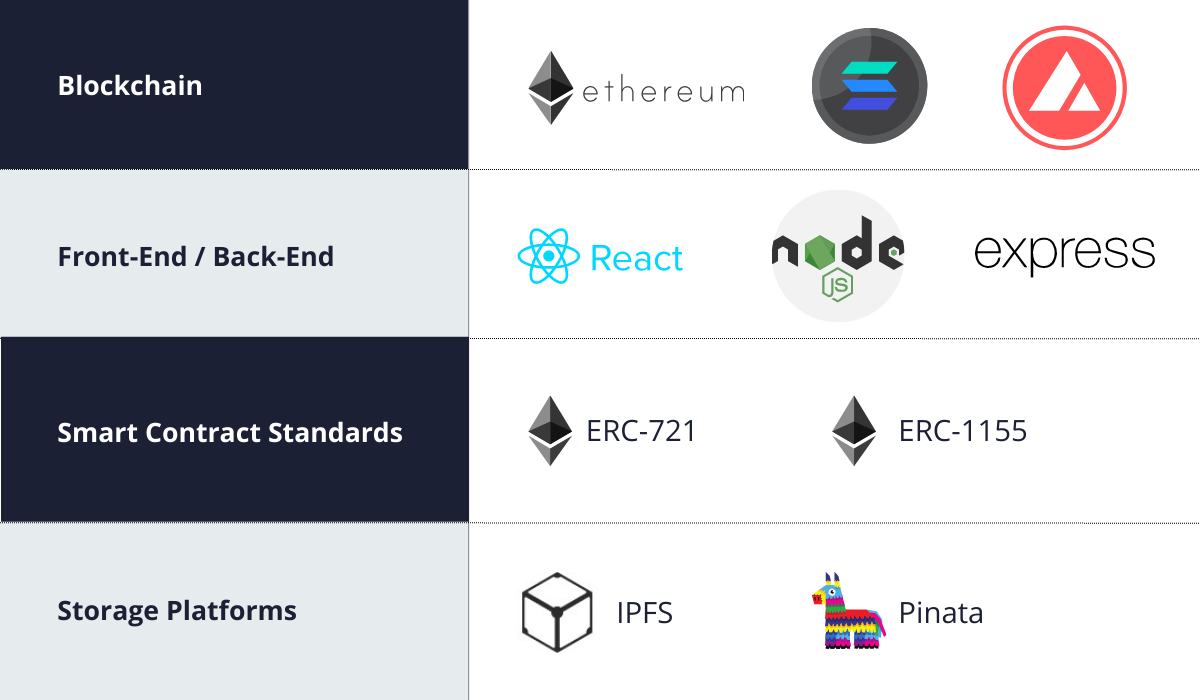
 

NFT minting tech stack


Steps to Create an NFT Minting Platform

The first thing you’ll need is a good blockchain platform to build your minting on. There are many different options available, but we recommend using Matic (a level 2 blockchain) or Ethereum. Both offer a range of features and functionality that is perfect for this purpose.

The steps to create the platform are:

  •  Setup Javascript development environment with Nodejs – use either Expressjs or Reactjs.
  •  Setup IPFS nodes and connect to the network (alternatively use Piñata)
  •  Deploy an NFT contract
  •  Program Tatum.io API to perform ground-level operations
  •  Publish the platform and mint NFTs!


Step One: Setting up Your Development Environment

To create an NFT minting platform, you will need to set up a development environment. This can be done using Nodejs and Expressjs or Reactjs. Once you have set up your development environment, you will need to install the Tatum.io API.

In order to install the Tatum.io API, you need to go to their website and click on ‘Get API key’ on that specific product page. Tatum also has the option for Javascript with Tatum JS, but if you are looking for other options, you can check this out.


Step Two: Setting Up IPFS Nodes and Connecting to the Network

If you choose to use IPFS nodes, you will need to connect them to the network and set up permissions.

Alternatively, you can use Piñata to manage your NFTs. On their website, Pinata states that they are the only solution that allows users to hide their files from the public IPFS network. The process of making these files private is referred to as ‘submarining’. With Pinata, you can have access control with custom permissions, and have the ability to make the files public whenever you want.


Step Three: Deploying an NFT Contract

To mint NFTs, you will need to deploy an NFT contract. There are several open-source contracts available that can be quickly customized and deployed. You will also need to have some technical competence, especially if you’re working with a contract that has already been written by someone else. In order to deploy a contract, you need to write the deploy script. This involves creating a file called “deploy.js”. You can read up on this more here.


Step Four: Programming the Tatum.io API

Once you have deployed your NFT contract, you will need to write code to use Tatum.io API to perform ground-level operations. This will include such tasks as creating new NFTs, retrieving information about existing tokens, and issuing transfers.


Step Five: Publishing Your Platform and Minting NFTs!

Once you have completed all of the steps listed above, it’s time to publish your platform and start minting NFTs!


Current Trends in NFT Minting

When it comes to NFT minting, there are numerous trends going around, some that will only become more mainstream, and others that could easily be termed ‘fads’. You decide which trends you would put into which category.


NFT Art

If there is one industry that really knows how to make good use of NFTs, that is the digital art industry. Artists are quickly hopping on the NFT trend as a second attempt to make generous profits off of their art and get credit for their own work. There are artists making thousands of dollars for their digital assets!


Gaming with NFTs

We briefly discussed previously that NFTs are being applied to the gaming world, with the ‘play-to-earn’ model and more. There are a number of gaming companies that are moving towards a tokenization model, which would involve players spending money to unlock in-game features. What’s even more cool is that people are buying ‘virtual real-estate’ in some games with NFTs! This brings us to our next point…


NFT Real-Estate Transactions

Yes, you can now buy property with NFTs in some games. The game ‘Decentraland’ is one such example where people are buying land and building on it. These virtual worlds are only going to become more popular as time goes on and technology improves.


Web 3.0 Identities

Since Web 3.0 will already be decentralized, it’s safe to say that NFTs can easily take over in this field. One way that NFTs can serve a powerful role in Web 3.0 is to help create digital identities. This is to ensure that each person will have their own unique identity, and that nobody will be able to have the exact same identity.


Independent Musicians

You remember when we discussed how artists lose potential profits by working with art galleries and other middlemen? The same goes for the music industries. Music artists go through more pressures because many record label companies and music streaming platforms snatch away the artists’ creative freedom. Having to commit to these companies is a major pain for singers and bands, and so they are turning to NFTs. Music artists are selling their discographies as NFTs and releasing their content on decentralized music platforms. The TV industry is also quickly hopping on the same trend.

Wearing NFTs

Luxury fashion brands such as Gucci and Hermes are utilizing NFTs to provide their audiences with exclusive and immersive content. These high-end fashion brands have started to release digital art and experiences that can only be accessed if you wear their clothes. For example, you might need to own a pair of Hermes shoes in order to see an animated short film or experience an art installation. This is a great way for these companies to increase customer loyalty and engagement.


Monetizing Social Media

There are talks of making profile pictures an NFT. Also did you know that there are tweets being sold as NFTs for millions of dollars? It might sound ridiculous, but it’s happening. As we move towards a more digital world, it was only a matter of time before social media would be tokenized. We are already seeing platforms like Reddit and Twitter experimenting with NFTs, and it won’t be long until this becomes the norm.


Where NFTs Are Headed

The future of NFTs is looking very bright, and we can expect to see many more innovative applications and use cases in the years to come. Here are just a few examples of where NFTs might be headed:


Growth of NFT Marketplaces

Right now, OpenSea is the largest NFT marketplace. It sells anything from art pieces to other rare collectibles. There are many other marketplaces following it’s lead, such as Binance and Mintable, and the good thing about these platforms is that they remove the need to be able to code. This makes minting NFTs as simple as possible for everyone. With the growth of NFTs, these marketplaces and minting platforms are expected to grow as well.


Representation of Physical Goods

NFTs have largely been known to represent digital assets only. However, they are being brought to the physical world as well. People are able to claim ownership of a tangible item with an NFT token. For example, if someone wants a rare hoodie of a certain fandom, they can trade the NFT token to receive the hoodie in exchange. Upon the exchange however, the NFT token must be destroyed to prevent replication.


NFTs becoming more ‘social’

If you interact too much on social sites like Instagram, you will often see a message that goes along the lines of ‘we restrict certain activities to protect our community’. Many users have reported that they have received this message even though they have owned their Instagram account for over five years and just enjoy interacting with the app regularly. On the other hand, there are decentralized social media apps emerging which pay users and content creators for the same level of interaction. Now tell us, which one would be more preferable?
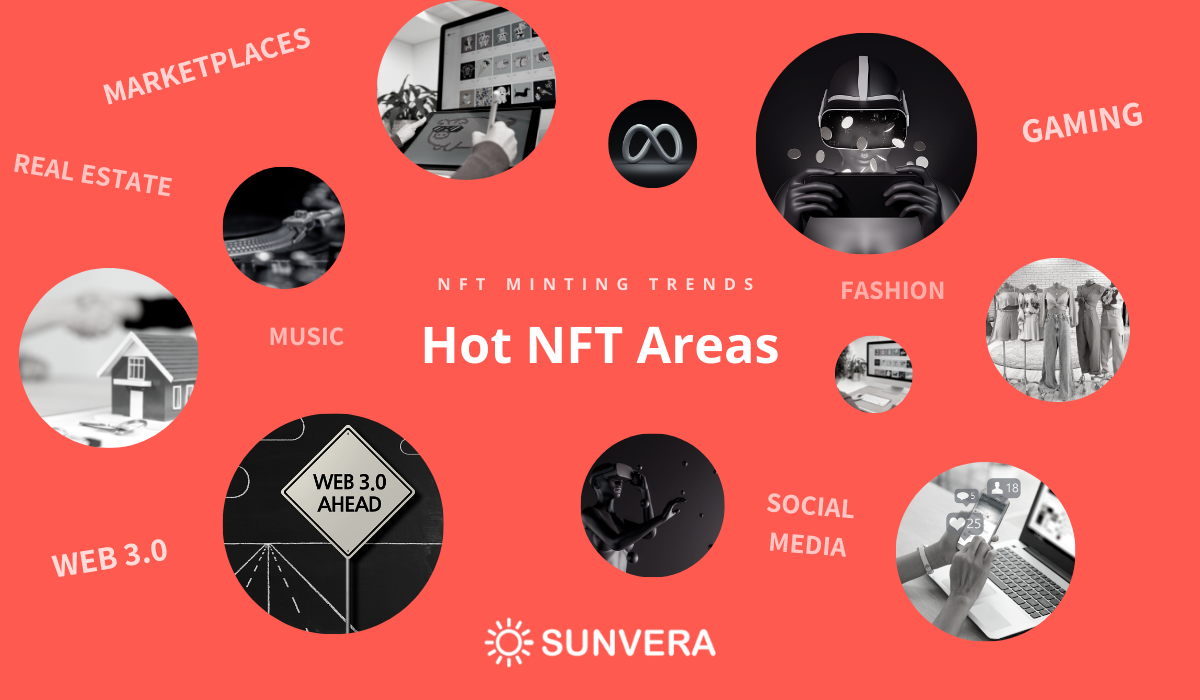
Hot NFT areas


Why You Should Invest in NFT Minting

If you clicked on this article, you must have had a desire to build the next major NFT minting platform, judging by the current demand for it. There are many reasons why you should invest in an NFT minting platform.

For one, there is immense potential to make huge profits off of NFT minting platforms. We are already seeing this with top NFT projects selling for millions of dollars. You can take a look at these millennials making large profits selling NFTs.

In the next five years, the world is expected to shift more towards immersive experiences with the emergence of artificial intelligence, virtual reality, and augmented reality. Throw cryptocurrency and NFTs into the picture and we have a more immersive world. People will start spending more and more time in these digital realms, that the growth of NFTs will be (and already are) inevitable.

We are only seeing the beginning of what is possible with NFTs, and we can expect to see even more amazing things in the future.


Sunvera Software develops next-level software applications from start-to-finish. We are a premier software and mobile app development agency specializing in healthcare mobile app development, custom mobile app development, telehealth software, sales dashboards, custom mobile app development services, retail software development, supply-chain software, ecommerce, Shopify, web design, iBeacon apps, security solutions and unified access software.

We are proud partners with Amazon AWS, Microsoft Azure and Google Cloud.

Schedule a free 30-minute call with us to discuss your business, or you can give us a call at (949) 284-6300.


How To Send Bulk Text Messages on Schedule?

Text messaging

Almost all text messaging marketing efforts geared towards driving sales started with a text message activity. Alternatively, you can choose to send bulk messages to all or selected individuals within a geographical region or community.

SMS (text messages) or MMS (multimedia text messages) based texts would use the same mechanism to set up and send as a single SMS. Bulk SMS can be sent both manually and automatically.

SMS marketing is one of the most important aspects of any internet marketing campaign. Keeping in touch with your clients and getting them to do business with you are two of the hardest tasks any marketer has to face.

So without further ado, here is how to send bulk text messages on schedule.


What is Bulk SMS OR Bulk Text Messages?

Almost everyone reading an SMS message has access to a mobile phone, which is why there are more mobile phones than toothbrushes. SMS boasts an unrivalled open rate of 98% for good reason! Since 90% of adults keep their mobile phones close at hand at all times, SMS messages are read on average within 90 seconds of being sent.

So how does a bulk SMS service work? Generally speaking, it is an application-to-person (A2P) messaging service that allows users to send a large number of messages to several recipients.

A bulk text message package allows you to send messages from any computer at any time (while email and phone have their limitations). It is possible to send bulk text messages in more than one way, but what we are going to explain will get you up and running in no time.


How to Send Bulk Text Messages From Your PC on Schedule

Businesses can easily target their target market by sending SMS messages in bulk from a PC to get in touch with them. With an advanced online SMS platform, you can reach your customers anytime, anywhere.

Sending bulk SMS messages from your PC is easy with the three methods listed below:


1. Using a bulk SMS sending service.

One of the most popular and efficient ways to send bulk SMS messages from your PC is by using an online SMS platform, such as ClickSend or Textmagic. These platforms allow you to easily create and send text messages to large groups through your computer, with scheduling features that allow you to send your messages at a specific time, or on a recurring schedule.


2. Using an SMS marketing software program.

Another option for sending bulk SMS messages from your PC is to use an SMS marketing software platform such as BulkSMS or Call Loop. These programs provide you with a wide range of features that make it easy to create and send text messages to your target audience, including the ability to segment your contacts based on various criteria, detailed reporting features, scheduling options, and more.


3. Automating SMS sending with an API integration.

A third option for sending bulk SMS messages from your PC is to automate the process using an API integration with your CRM system or another software program. This option requires a bit more technical know-how, but can be a great way to streamline the process of sending bulk SMS messages from your PC if you are already using a CRM system or other software that offers API integration.


Top SMS API Providers In 2022

If you choose to use the API integration option, here are a handful of some of the best SMS API providers you need to know.


Twilio SMS API

With Twilio’s SMS API feature, you can send and receive SMS messages, track the delivery of your messages sent, schedule messages, and even retrieve and modify your message history. Twilio’s API is also very secure, as it is served over the HTTPS protocol.


Telesign SMS Verify API

On the topic of safety, Telesign offers a very useful phone verification API that helps add an additional layer of security to your company systems. What it does is it sends voice and SMS verification codes for single-use to increase account security. Telesign also uses two-factor authentication to prevent fraud. This service is used to protect your customer and your business, verify transactions, and prevent fake accounts.


D7 SMS API

The company D7 has also made some glorious efforts in helping ease interaction with customers, with their messaging and SMS API. This developer-friendly API supports normal and Unicode message text, two-factor authentication, and two-way messaging. D7 also delivers 24/7 support for all your questions and inquiries.


Telnyx API

Another API that can be effectively used for authentication is the Telnyx API. This API allows users to track calls, get real-time analytics, and use two-factor authentication. The Telnyx API is also known for its low latency and high security standards.


MessageBird API

MessageBird’s API allows users to seamlessly integrate various communication features such as SMS, chat, and voice functionalities to their website or app. They use an access key for their API Authorization framework. Before using the MessageBird API, however, you need to sign up on their website.


ClickSend API

Lastly, ClickSend offers many different API options that serve different functions. On their website, you can see API options for Rest API, which is their latest and most recommended API. Additionally, you can select their HTTP, SMPP, SMTP, FTP, and SOAP APIs.


Email to SMS

An email account can be used to send a text message from your own computer, eliminating the need to add a new feature to your CRM system, log into a special website, or upload bulk lists via CSV files. It is simple to handle user replies with many emails to SMS providers. Text messages also open the door to instant two-way communication, which is very useful when rotating staff or scheduling appointments. While using an email to SMS provider, you will need to have access to your email client, rather than a web-based solution.


Top Email To SMS Providers In 2022

  1. ClickSend – Best Email To SMS Service
  2. Burst SMS – Cheap SMS Rates
  3. MessageMedia – Large Business SMS
  4. MessageBird – The Global Mobile Network
  5. SMS Global – Top Features of Email To SMS
  6. Twilio – Messaging for Large Organizations
  7. Clickatell – The Best Premium SMS Service
  8. EZTexting – Text Messages For SMEs


How to Send Bulk SMS/Text Through iOS Apps on Schedule

Sending bulk messages through iOS apps is a great way to promote your products, reach out to your target market, and engage with customers on the go. Whether you are promoting an event or just keeping in touch with clients, there are a number of apps available that can help you send bulk SMS messages through your iOS device quickly and easily.


Top iOS Bulk SMS Apps In 2022

Here is our list of the top iOS apps for sending bulk SMS messages:


BulkSMS by EZ Texting

BulkSMS by EZ Texting is a bulk SMS messaging app that allows you to send text messages to large groups of contacts with the tap of a button. With BulkSMS, you can easily create and manage your contact lists, schedule messages to be sent at a later time, and track the delivery of your texts to ensure that they are being received by your contacts.


Textline

Textline is a secure SMS marketing and customer engagement app that offers a number of features to help you reach out to your target market and engage with customers through text messages. With Textline, you can improve relationships with customers by engaging in effective two-way conversation without being spammy. Textline also offers automation tools to streamline the entire customer engagement process, while adding a personal touch. Lastly, Textline makes it easy to manage replies from customers and integrate SMS messaging into your existing workflows.


Bulk SMS by Mo+

If you are looking for a quick and easy way to send bulk SMS messages through your iOS device, Bulk SMS by Mo+ is an excellent choice. This app allows you to quickly build contact lists and schedule messages to be sent at a later time, giving you more flexibility in how and when you reach out to your target market. You can follow up with your contacts at a later time as well with their Reminders feature. The good thing about Textmo is that instead of the traditional 160 character limit, this platform allows your messages to be up to 306 characters long.


iMessage

If you want to send bulk SMS messages through your iPhone, iMessage is a great option. Most people are aware of iMessage since it is the top messaging tool that iPhone users use. With iMessage, you can easily create group chats with up to 200 contacts and send text, photos, videos, and documents to your contacts all at once.

Whether you are promoting an event or just keeping in touch with customers, iMessage is a powerful tool that can help you reach out to your target market and engage with customers through SMS messaging. With iMessage, there is no app to download since this one is already built into iPhones! Another plus side to iMessage is that the messages can be sent and received not just on iPhones, but also on the iPad and Mac.


SMS Magic

SMS Magic is an AI-powered customer engagement app that offers a number of features to help you reach out to your target market and engage with customers through text messages. The unique aspect of this app is that it integrates with various chat apps such as WhatsApp, Facebook Messenger, and LINE, as well as traditional text, to reach the maximum amount of contacts. Through this app, you can improve customer service as well as being able to get a large number of attendees for an event through effective reminder texts.


MessageBird

Similar to SMS Magic, MessageBird also allows you to integrate with some of the top communication channels that customers prefer to engage with them in two-way messaging. Not only that, but you can also integrate with third-party services such as Shopify to personalize interactions. MessageBird comes with helpful security features such as two-factor authentication to ensure confidentiality. MessageBird helps you unify all of your channels into a single shared inbox for convenience.


Zendesk

Lastly, Zendesk is a customer service platform that offers the ability to send bulk email messages as well. This can come in handy if you want to reach out to your target market with a promotional offer or upcoming event. With Zendesk, you can easily track who opens and clicks on your emails, as well as get detailed reports. You can also segment your contact lists to target specific groups with more personalized messages. You can send up to 300 emails within a 24-hour period with this app.


How to Send Bulk SMS/Text Through Android Apps on Schedule

There are several reasons to schedule text messages ahead of time, whether you want to send a quick “happy belated birthday” message to a family member or friend, or you have friends who work a different schedule than you do. Originally, Android users could only schedule messages to be sent later through apps. Today, you can schedule messages through stock Android SMS apps as well as multiple apps.


Top Android Bulk SMS Apps In 2022

We have also compiled a list of the top Android bulk SMS apps for our fellow Android users:


Chomp SMS

With over 10 million users, Chomp SMS is a feature-rich Android app that lets you easily send bulk SMS messages to multiple contacts. This app makes the standard texting app look boring, with fun customization features such as notification LED colors, fun ringtones, and vibrate patterns. It also has some very useful built-in privacy and security features such as a passcode lock, the ability to stop a text while it is still sending (which can be a lifesaver!), backup features, and even convenience features such as replying from your lock-screen.


MightyText

Ever wanted to send a text message right from your computer? Well, MightyText allows you to do that! With this app, you are able to text from any device you wish, whether it be your phone, laptop, desktop, or tablet. You can receive your phone notifications on your laptop screen. Plus, MightyText also comes with some very neat features such as 1-click photo sharing, scheduling messages, texting directly from Gmail, and syncing messages to your email as a backup. It’s a great app for those who don’t always have access to their phone and are looking for a more convenient option.


Pulse SMS

Pulse SMS is a powerful scheduling app for Android users who want to send bulk text messages on the go. Pulse SMS offers a number of features to help you create, send, and track the performance of your campaigns with ease. Some of the notable features include pinning favorite contacts, blacklisting unwanted contacts, dual SIM support, end-to-end encryption for enhanced security, web previews for articles and YouTube videos, and a mute and snooze option to help prevent distractions when you are tied up with something.


Textra SMS

Lastly, another fun Android SMS app that comes with various customization features, similar to Chomp SMS, is Textra SMS. This app comes with 180+ colors for various in-app elements and allows you to schedule text messages to send at a later time. A key feature of this app, which is not so common on most of the Android SMS app options available, is the ability to automatically compress image and video files that are too large. This allows for seamless communication.

Another exciting feature of this app is its support for reactions, which is much like the iOS reactions. It’s a great app overall whether you are looking for an app to communicate with customers or just upgrade your texting game in general.


How To Send Bulk SMS/Text Messaging From Your Samsung Phone on Schedule

When you need to communicate a message to multiple contacts at once, you can send mass SMS messages from your Samsung Galaxy. You can text a single message to every contact in your Contacts list from your device. Using the Galaxy’s Contact Groups feature, create an address book group that includes all of your contacts. The Galaxy’s Messaging app lets you send an all-inclusive contact group a single text message.


Create Contact Group

  1. Click the “Contacts” icon in the home screen of the Samsung Galaxy to access the Contacts list.
  2. To access the Groups form, tap the tab labeled “Groups”.
  3. When you click the “Menu” button, the “Create” option will appear.
  4. You can name the new group anything you like, for example, “All Contacts.”
  5. Select “Add Member” from the menu. You will be able to check each contact on the Contacts list when you open it.
  6. Select all contacts from your Contact list by checking the box “Select All,” then tap “OK.” All contacts from your Contact list are added to the new group.


Send Group Text

  1. From the Galaxy home screen, tap the “Contacts” icon, and then tap “Groups”.
  2. To create an inclusive contact group, tap the entry.
  3.  The Contact Group contact list appears after pressing the “Menu” key and selecting “Send Message.”
  4. After you tap “All,” the Messaging app opens and you will be able to create an SMS message.
  5. The text input box allows you to write a message to the group.
  6. You can send the message to all members of the contact group by tapping “Send”.


Conclusion

As a result of its many benefits, bulk text messaging revolutionizes customer interaction and will probably continue to do so over the long term. The ability to communicate with large numbers of people at once, in a way that is personal and immediate, is unrivaled by any other form of marketing or customer service. If used properly, it can be an invaluable tool for your business.

There are many providers of email to SMS services, and each has its own advantages. The provider you choose will depend on your individual needs and budget. To find the best provider for your business, do some research online or talk to other businesses that have experience with email to SMS services. Whatever provider you choose, make sure it offers reliable customer support and allows you to schedule bulk text messages on a regular basis.


Sunvera Software develops next-level software applications from start-to-finish. We are a premier software and mobile app development agency specializing in healthcare mobile app development, custom mobile app development, telehealth software, sales dashboards, custom mobile app development services, retail software development, supply-chain software, ecommerce, Shopify, web design, iBeacon apps, security solutions and unified access software.

We are proud partners with Amazon AWS, Microsoft Azure and Google Cloud.

Schedule a free 30-minute call with us to discuss your business, or you can give us a call at (949) 284-6300.

Mobile Marketing Automation: What is it?

Mobile app

With consumers spending more than five hours a day on their phones, businesses are keener than ever to find a way to engage with the user on their phones and harvest significant results.

Since most website traffic comes from mobile phones, 71% of marketers find mobile marketing a better and more productive way to generate leads. With technological advances at their peak, mobile app marketing automation is the goal of every other entrepreneur as it not only decreases the total input but increases the output significantly.

What is Mobile Marketing Automation (MMA)?

MMA is your algorithm-based virtual assistant that keeps track of the user activity on your app; where they spend the most time, what hours of the day they spend on your app, which buttons are tapped, and how much time is being spent. A plethora of other observations are also made and AI segments the users based on their actions. Consumer behavior analysis puts them into segments and sends prompts and messages accordingly. MMA does real-time marketing by tracing the user and sending a related prompt, message, email, or an SMS that leads them to a relevant campaign.

Cutting to the chase, MMA eliminates your need to stay behind the curtain and watch a user’s activity to create and manage your marketing campaign accordingly. MMA is just an intelligent alternative of your marketing team, working 24/7 like a control tower of your app.

An insight into real-time features of MMA

Real-Time Segmentation

Every marketing campaign creates segments based on the user’s behavior. Making it clear about the user behavior, it refers to the user’s location, the time they spend on the app, and the way they behave on the app. Based on the segments, personalized messages, prompts, emails, and SMSs are sent to the users.

The best thing about mobile marketing automation tools is that they give you real-time insight and analytics about your marketing campaign. You can immediately assess what tactic/approach is working and which one has failed to get things done. You can then make adjustments to match your desired goal.

Ongoing Personalization

Marketers reported having a 56% increase in sales when they used personalized marketing approaches. Mobile automation is always personalizing emails, prompts, SMSs, and product information for the customers. Adjustments are made based on customer preference, location, and loyalty to your brand. Since you know what’s happening in the app, you can use those analytics for many things.

The Working of Mobile Market Automation

Mobile marketing automation is a system that is working behind the scenes. From using data such as Geolocation to assessing the customer’s behavior and sending emails accordingly is a part of what it does. MMA is aimed at increasing engagement and user awareness. Whenever the user is not using the app, sending those emails and messages about your app might not be fruitful. With MMA, you know when a user is on your app, and you can ask them a quick question to engage with them.

Benefits of MMA

  • The Best Channel for Reaching Users

Automation giving valuable insights into the user’s behavior helps to choose the best channel for reaching the user. Whether it’s an email, SMS, or an in-app prompt, you get the best response when you know what the user is up to. 

  • The entirety of User Data Available for Analysis

Mobile marketing automation gives you the liberty to access a wide array of user data useful in customer relationship management. Having 360-degree data of a user, their geolocation, social data, and in-app preferences lay a solid base for organizing the marketing strategy. Moreover, this data can be used for crucial sales-related analysis. 

  • Efficient in many ways

Since the automation does not need you to be vigilant and careful about the messaging and emails, you can save time for other tasks. Moreover, handling a marketing team is a hectic job, and all the statistics point towards the automation of marketing since it is high time to automate work processes and make the best use of your time. 

Mobile marketing automation tools are changing the structure of marketing models in businesses. With its excellent work process, MMA will cast its shadow over the famous marketing models and be an integral part of digital marketing. It is not long when the acronym MMA will be well-known for Mobile market automation rather than Mixed Martial Arts.

Along with mobile marketing automation, you may want to check out these 24 Digital Marketing Mistakes to Avoid in 2022.


Contact us to discuss your business today.

A Guide to HIPAA Compliant Video Conferencing

HIPAA compliance document

The COVID-19 situation has prompted thousands of healthcare organizations to turn to online video conferencing to serve their patients. With numerous video conferencing platforms that claim to be HIPAA compliant, many doctors and physicians do not think twice before switching to one. However, there is a lot more you need to know before making the transition to serving patients online through video. It turns out, the current video conferencing platforms in the market may not be HIPAA compliant after all, and the issue of privacy and security persists within these offerings. 

Let’s start from the very beginning so you can get a better idea of what HIPAA compliant really means and how you can securely implement it for your healthcare organization. 

Who Needs To Comply with HIPAA?

Covered Entities: There are three types of ‘covered entities’ under HIPAA. These are health plans, clearinghouses, and certain healthcare providers such as doctors, dentists, pharmacies, clinics, etc., as long as they transmit data in an electronic form that is in connection with a transaction for which HHS has adopted standards.

Business Associates: These are people or entities that carry out tasks involving the use or disclosure of protected health info on behalf of a covered entity or to provide services to them. Some examples are a CPA firm who needs to access protected healthcare info to provide accounting services to a healthcare provider, or an outside medical transcriptionist providing transcription services to a physician

Organizations That Do Not Need To Comply with HIPAA

According to ShareCare, the following organizations are not required to follow HIPAA guidelines:

  • Life insurers
  • Employers
  • Workers’ compensation carriers
  • Most schools and school districts
  • Many state agencies, including child protective agencies
  • Most law enforcement agencies
  • Many municipal offices

Issues with Current ‘HIPAA Compliant’ Video Conferencing Platforms

Zoom: As one of the most-used video conferencing platforms right now, whether it is for a family reunion or a telehealth appointment, Zoom has quite the reputation for being a reliable platform for communication. However, several issues about Zoom not being HIPAA compliant have come into light this year. From hijacking attacks to malware threats, Zoom has undergone a lot of stress trying to solve the various security concerns. Although they may have found a solution to some of the privacy concerns, this popular video conferencing platform is still not deemed entirely HIPAA compliant as there are still remaining issues to fix.

GoToMeeting: Another widely-used platform to schedule meetings online, GoToMeeting also fell prey to online security concerns this year, including a unique vulnerability that exposed its customers to a lot of risk. They were able to resolve it, but no one can predict when something like this can happen again. 

These are just some of the platforms that are deemed as HIPAA compliant, even though they pose numerous security issues. 

Skype and Facetime Are NOT HIPAA Compliant

It is crucial to note that Skype and Facetime, while they can be good platforms for informal communication, CANNOT be used for telehealth services. The reason is because they do not fully meet the criteria that we are about to cover in the next section. There are a number of healthcare providers who think that Skype and Facetime are reliable platforms when they are far from being HIPAA compliant

So How Do You Implement HIPAA Compliant Video Conferencing?

Here are some components of HIPAA compliance that you need to know before implementing this technology.

End-to-End Encryption: When implementing a secure video conferencing for your healthcare organization, the very first feature to look out for is end-to-end encryption. This means that only the sender’s device and the receiver’s device can encrypt and decrypt messages sent back and forth, offering a much higher level of security. 

Business Associate Agreement (BAA): A step that covered entities often forget, you need to make sure you have a Business Associate Agreement in place to further protect healthcare info and comply by HIPAA guidelines. You can read more about BAAs here

Peer-to-Peer Sessions: For enhanced quality and security, you also want to check and see if the video is routed directly to the patient’s device, or if it involves a server. Direct peer-to-peer sessions without the need for a server is the best route to go. 

For best practices, your video conferencing solution should have all three of the features listed above. 

With that being said, instead of going forward with risky platforms that yet need improvement, it is best to find a good software development agency with decades of development experience including telehealth solutions to craft the perfect secure video conferencing platform for your healthcare organization, which meets all HIPAA guidelines. 

Sunvera can help you implement the right software solution for your healthcare organization while helping you reduce costs and improve operational efficiency. Contact us for a FREE 2-hour consultation.  

Outsourcing Application Development: Why Businesses Do It

Outsourcing

Outsourcing application development has been around for a long time, and this is a great option for companies that lack experience or expertise in application development. The term “outsourcing” refers to a third-party application development company for iOS or Android that will develop for you. In short, when you hire someone to create an app for you, you outsource the development of mobile apps.

Mobile application outsourcing unlocks the door to a broader range of abilities, expertise, application traits, layout templates, and an infinite number of expert developers. By contrast, internal developers limit your capabilities, which can scare you away.

You choose between several development outsourcing options, and they are:

  • Development companies
  • Freelance application developers
  • Ready solutions

The Necessity of Outsourcing Applications

You probably think it’s better to hire an internal team of application developers and designers that you can monitor and keep track of.

Why does someone choose to outsource developers? The answer is quite simple. Outsourcing is an opportunity that enables you to save money, suggest many features, and allows you to use all the latest technologies possible in the market.

Some other benefits include:

Faster development process

The process of outsourcing mobile applications is efficient and fast. A reputable software development firm is far superior to freelancers and staff due to faster order time.

How is this possible?

Because when you choose a firm, you hire a team that combines developers, investigators, planners, and supervisors. The whole unit will serve together and persistently show the results. However, hiring your team will take a lot more time and effort, which will affect the order completion time.

Access many talented developers

If you demand a mobile app by excitement, hiring a faculty team will limit your time and selection of the best resources. Finding, interviewing, testing, and adding resources to your staff is a long process, but you can save time by hiring the company that will create your mobile app.

Way to a complete polished tech stack

A software company will have infinite information about the newest technology and will be able to fully leverage it than your in-house unit. They will have a way to all the technology, grip all the skills, and practice all the advanced arts and tools to bring to life even the most complex app with market-competitive qualities.

Although outsourcing application development gives you little control over the application creation process, it can save you on the cost of hiring. The extensive recruitment process will cost more than the choice of outsourcing. You have the opportunity to hire offshore firms from regions where the application can be created within the budget. And who wouldn’t want to minimize expenses? FACT: About 59% of companies claim to hire offshore firms because outsourcing applications are cheaper.

Advantages of mobile app outsourcing

A lot of experience. Thanks to many similar projects implemented, outsourcing companies have gained extensive experience in the business sphere and technical solutions for quick and effective problem-solving. So they understand application requirements better.

Highly qualified outsourcing teams can easily replace full-time specialists, bringing knowledge and experience that would otherwise require much more time and money.

In addition, outsourcing companies with extensive experience can have a broader view of industry trends and act as business consultants to guide the development of your project. You can find new approaches and innovative ways to accomplish tasks that will promote change and innovation in your business.

Broadly Spread and Highly developed

The outsourcing firm has under its roof a full range of IT professionals

These specialists can be easily available on-demand and quickly hired for a limited time.

The supplier can easily and relatively quickly increase or reduce the size of the team to meet changing product or business needs.

Ultimately, an outsourcing company feature can be easily disqualified from the project or replaced. Usually, for outsourcing companies, this means only staff rotation between different projects, not dismissal.

Economic efficiency

Well-qualified developers in offshore regions, such as Eastern Europe or India, are cheaper. This is particularly right for companies with offices in Silicon west Valley, London, and other areas where it is very costly to live. Moreover, because of the high competition for talent in these regions, it is difficult to find developers, so hiring takes much longer.

There is no need to build, manage an entire office, and carry the associated expenses. Development agencies credit an hourly rate, which covers the cost of developers, tools, maintenance, and co-operations after ship. Working with outsourcing companies, the business saves on a lease, IT-ecosystems and corporate events, benefits, and other overheads.

Deficiency of micro-management

There is no need to waste a lot of time contracting, coaching, and hiring staff. By outsourcing team development, companies can better focus on business development and operations. Directors of the team, improve speed, and quality trust is committed to the outsourcing team. This means that the customer can analyze the performance metrics of the application and the engineering team KPI for decision-making instead of delving into the cause and effect analysis.

According to the Santos study, almost 68% of the organizations inspected have outsourced software development at least once, and about 62% are happy with the outcome.

Cross-platform application development

Cross-platform application development is the invention of a single application that can operate on different operating modes, alternately designing different versions for each platform.

The driving push behind the growth of cross-platform applications is the piece of software that works great in more than one specific digital ecosystem, with the chief objective of marketing it to full customer support.

Benefits

Compared to a native solution, cross-platform application development, in which mobile application developers must write only one code base for both mobile platforms (iOS and Android), gives companies, especially SMB (small and medium business) and startups, the following advantages:

Effective development expense

Native development demands developers to compose separate code bases for various programs (iOS and Android), managing to a doubling of forces and sources. In opposition, cross-platform developers need to write a codebase only once, and then publish the application on both platforms at the same time. This results in lower cross-platform development costs, allowing companies to save money.

Save time and run quickly

The need to write code only once allows companies to shorten development time, quickly bring their product to the application market, and capture a valuable market share from first users.

Performance close to native

With new technologies like React Native and Flutter, cross-platform applications can now function as easily as native applications, providing users with a very pleasant experience with the application and UI/UX, close to native.

What is Native Application Development

The term “native application development” refers to the creation of a mobile application for only one platform. The application is created using programming languages and tools specific to the same platform. For instance, you can produce a native application for Android adopting Java, and for applications for iOS, you can use Swift and Objective-C.

Native applications are known to provide exceptional user experience, as they typically provide high performance. User experience is also improving as visual effects are adapted to the UX platform. However, startups are concerned about the high price of producing domestic applications because they demand to originate together for both programs.

Advantages of native application development

Broad functionality

You will have access to all APIs and tools provided by the platform you work on. Technically, there are no restrictions on how programmers can work with the new application.

Best store support

The native application is easier to publish and is typically higher in the platform’s application store because it provides better performance and speed.

Improved Abilities

Applications built for the native conditions also favor being more scalable, with versatility in support supervision.

High performance and excellent UX

Direct communication between code and base resources provides high performance. In addition, native applications typically have the best UX.

Sunvera Software develops next-level software applications from start-to-finish. Schedule a free 30-minute call with us to discuss your business and the process of outsourcing application development to us, or you can give us a call at (949) 284-6300.

App Development Cost 2022: A Complete Guide

App development graphic

Mobile phones have become a necessity in our lives, and a phone without apps is a useless screen. Around 90% of the time people spend on their phones is on an app. With more than 2.9 million apps available for downloads, it is clear that apps are an effective way to engage the audience and build brand credibility. This comprehensive guide will lay down the roadmap of app-building costs and what route to take depending on your needs.


App Development Costs

When it comes to app development cost, there is no specific answer to how much it can be as the price depends on various factors. The average cost range of developing a mobile application is anywhere between $20,000 and $80,000.

When you set out to develop an app, you can take several routes to ensure that your project does not go over budget, and you can also opt for freelancers instead of going for development companies.

One of the most widespread beliefs in app development is that the more money you cough up, the better the app will be. This is not true because you could opt to work with a freelancer who would charge you significantly lower than what a company would. You could also talk to an app development company and look for areas that are not needed in your app at the moment and remove them, thus driving the cost down.

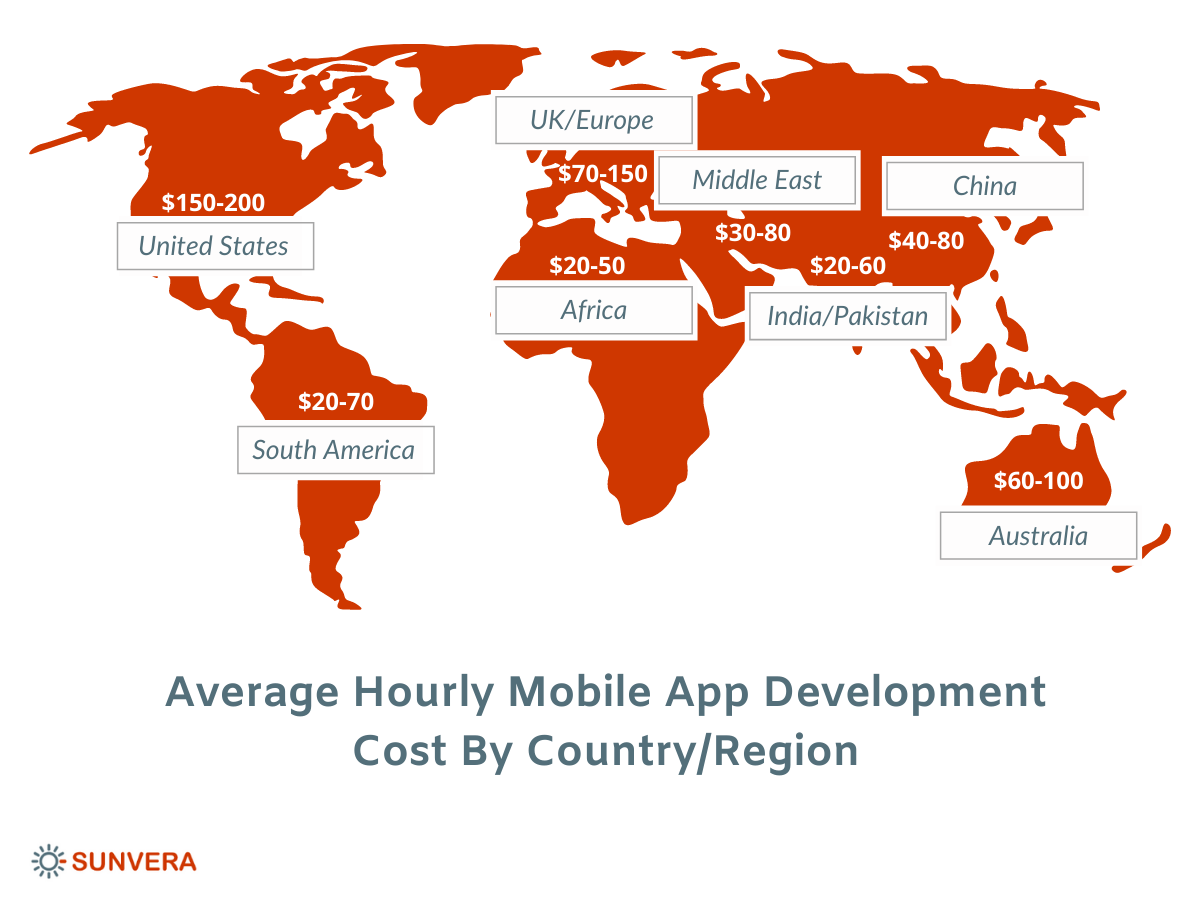
The cost of app development depends on where the developer is situated. For example, North America and Australia are some of the most expensive app development regions at $150-$200/hr and $168-$250 for iOS. In contrast, the most pocket-friendly options would be India, Indonesia, and Pakistan, each ranging between $11 to $70, respectively.

Average Hourly Mobile App Development Cost by Country

Average Hourly Mobile App Development Cost by Country

It’s Not Just About The Dollar Amount

If you have previously built an app, you know that it is just as important to capture the estimated number of hours that it will take to build your mobile app. The formula for calculating the price of app development is price/hr. X number of hours = total cost. With that being said, let’s use that formula to calculate the average cost of building each major type of app.


Types of Apps and Their Average Total Costs

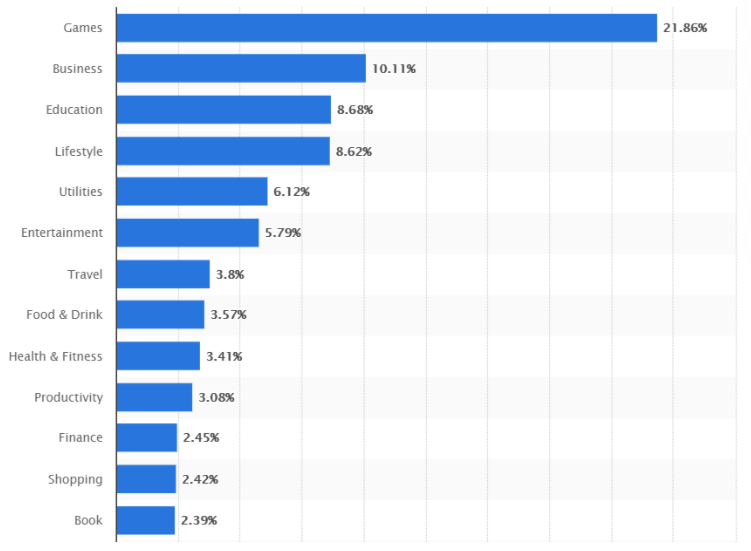
A major point to take into account is the type of app you want to build. Yes, it’s true that different types of apps have different cost levels. According to Statista, here are the most popular app store categories as of August 2020, and their percentage share of active apps in the app stores.

Most Popular App Store Categories, Statista

Most Popular App Store Categories, Statista

Here is a rundown of the top categories of apps and the average costs that they incur.


The Gaming App

Although it is one of the most popular categories in the app store, gaming apps generally require high-quality graphics and endless features. Games can be as simple as Solitaire or as complex as Fortnite, and with the rise of Augmented Reality (AR) and Virtual Reality (VR), games are about to become more complex in features. Depending on the kind of gaming app you want to build, it will cost you anywhere between $50,000-$1,000,000 to build one.


The Business App

A personalized app for your business can cost you anywhere between $50,000-$200,000. Business apps should start by offering these five basic features for your audience: user-friendliness, social integration, feedback and contact, offline features, and regular updates.


The Education App

How simple or complex do you want your education app to be? If you are creating an education app as a simple resource for students or potential learners to refer to, the price could be as low as $15,000. For more engaging educational games and advanced features such as interacting with tutors, you can expect the price to bump up to $80,000, or even more.


The Lifestyle App

Everybody is looking for different lifestyle apps that can help them track their everyday activities, such as their diet, what to wear, their workout routine etc. The good thing about lifestyle apps is that everyone can use them, so there is a wide audience. Building a feature-rich lifestyle app costs $15,000-$50,000 on average.


The Utilities App

Want to build a powerful voice translation app or a reminder app? Similar to lifestyle apps, utility apps are also in high-demand all the time. And the good news is that you can build one in five figures! Typical costs range from $25,000-$80,000.


App Trends on the Rise

AR/VR

It took one game to make this mobile app trend go viral and now, the market is expected to reach $94.4 billion by 2023. Augmented Reality and Virtual Reality apps are now spread across nearly every vertical and will soon take over the majority of apps in the app stores.


AI/ML

With increasing worldwide spending on emerging technologies, Artificial Intelligence (AI) and Machine Learning (ML) are now dominating apps. We will come to a point where many will not find an app desirable if it does not have some sort of AI/ML feature to make our lives simpler.


On-Demand Services

We have clearly seen how successful apps like Uber and DoorDash have been, and people now want on-demand service apps for just about everything. The interesting part is that there will be a lot of competition in this field as businesses build ‘the next Uber’ with more advanced features.


eCommerce

The pandemic has been testing all sorts of waters for sure, and the tides have actually been very eye-opening for retailers. eCommerce has always been an attractive option to reach more shoppers, but many businesses thought it would never overpower the personal, in-store connection that shoppers get when they walk into their store. However, retailers are now finding that eCommerce is fast, easy, convenient, and there are many ways to personalize the customer experience with AR/VR, chatbots, automatic suggestions etc.


Types of Apps From a Technological Standpoint

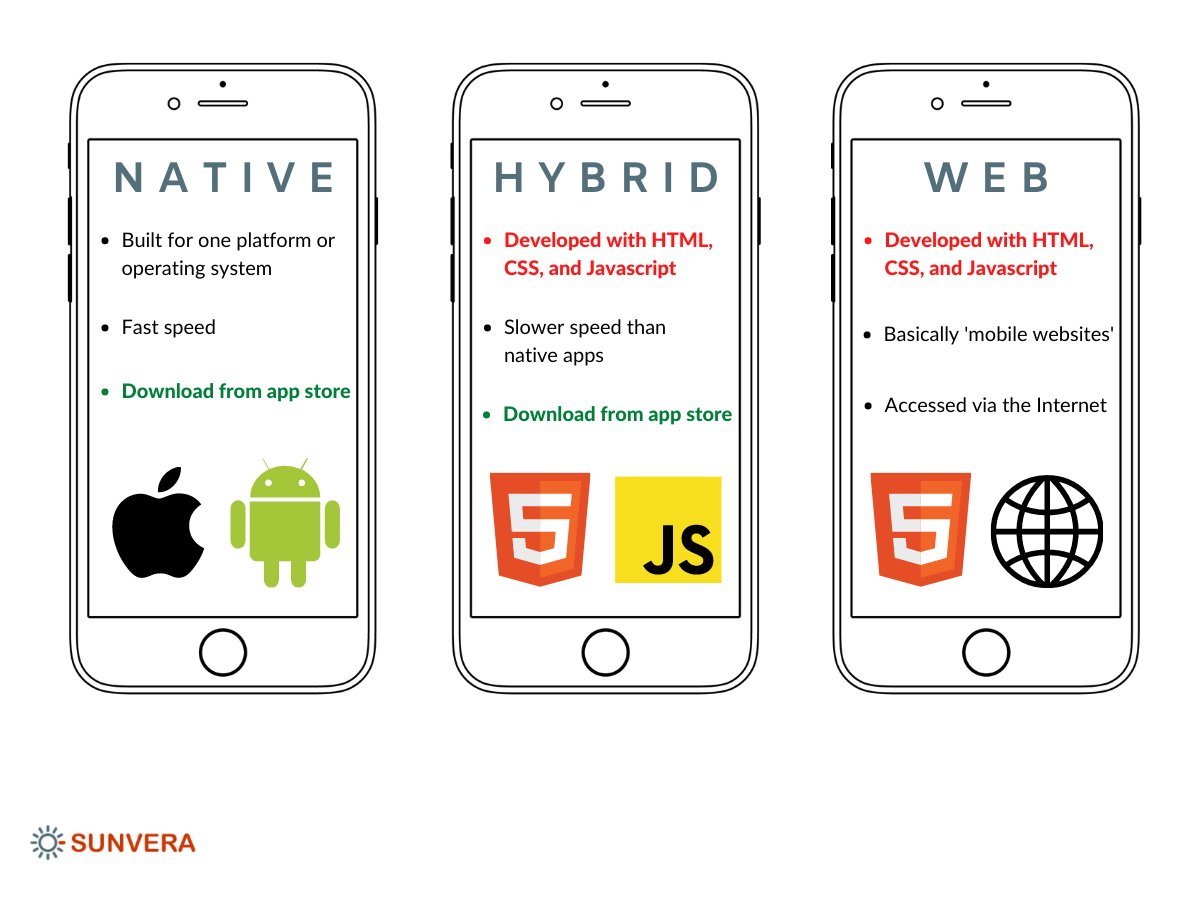
Native Apps

These apps are specifically built for one platform (ex. specific to only iOS or only Android). Native apps are the most popular choice out of the three options (native, web, and hybrid) due to their fast speed. However, they are the most expensive as well. The reason being that you have to build 2-3 native apps for it to be optimized for each type of device and/or platform.


Web Apps

Web apps are basically ‘mobile websites’, however, they may showcase a different look and feel from the same company’s desktop website. The good thing about web apps is that they do not need to be downloaded to be used as they can be accessed via data or the Internet. They also do not need to be built for multiple platforms so they tend to be cheaper than native apps.


Hybrid Apps

If you mix native and web apps together, you get hybrid apps. Hybrid apps are similar to native apps in the sense that you have to download them from the app store. However, similar to web apps, hybrid apps are developed using programming languages like HTML, CSS, and Javascript, and are cheaper than native apps.

Hybrid, Web, and Native Apps

Hybrid, Web, and Native Apps

iOS Apps

iOS apps are built with either Objective-C or Swift programming languages.


Android Apps

Android apps are primarily built with Java and Kotlin.


What The Surveys Tell Us

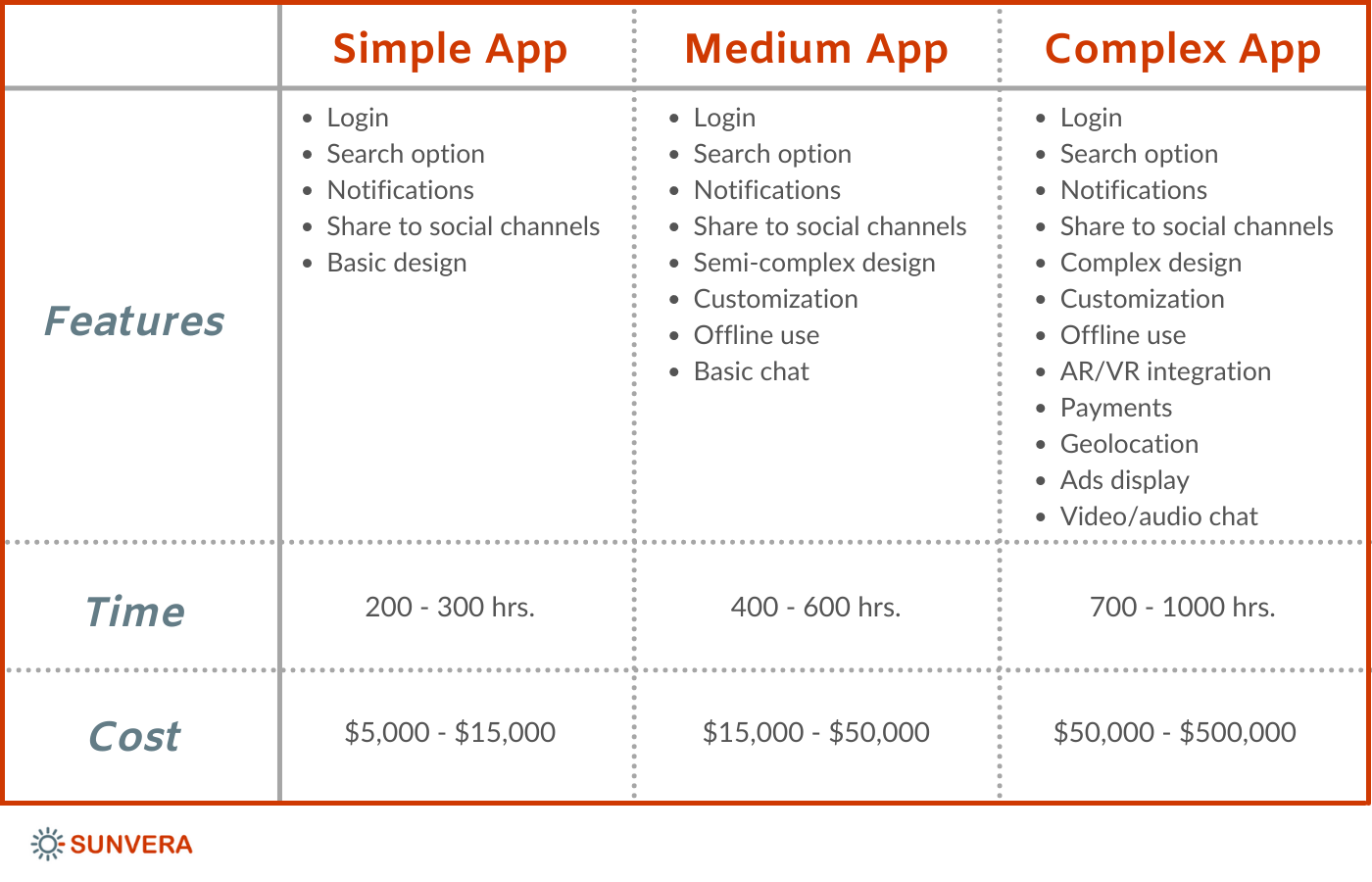
GoodFirms broke down the average cost of app development into three categories: apps with a simple interface (least functionality), medium complexity, and feature-rich apps. The most simple apps cost anywhere between $40,000 to $60,000. Apps with a little more complexity can cost between $61,000 to $69,000, and the most complex apps range from anywhere between $70,000 to $100,000.


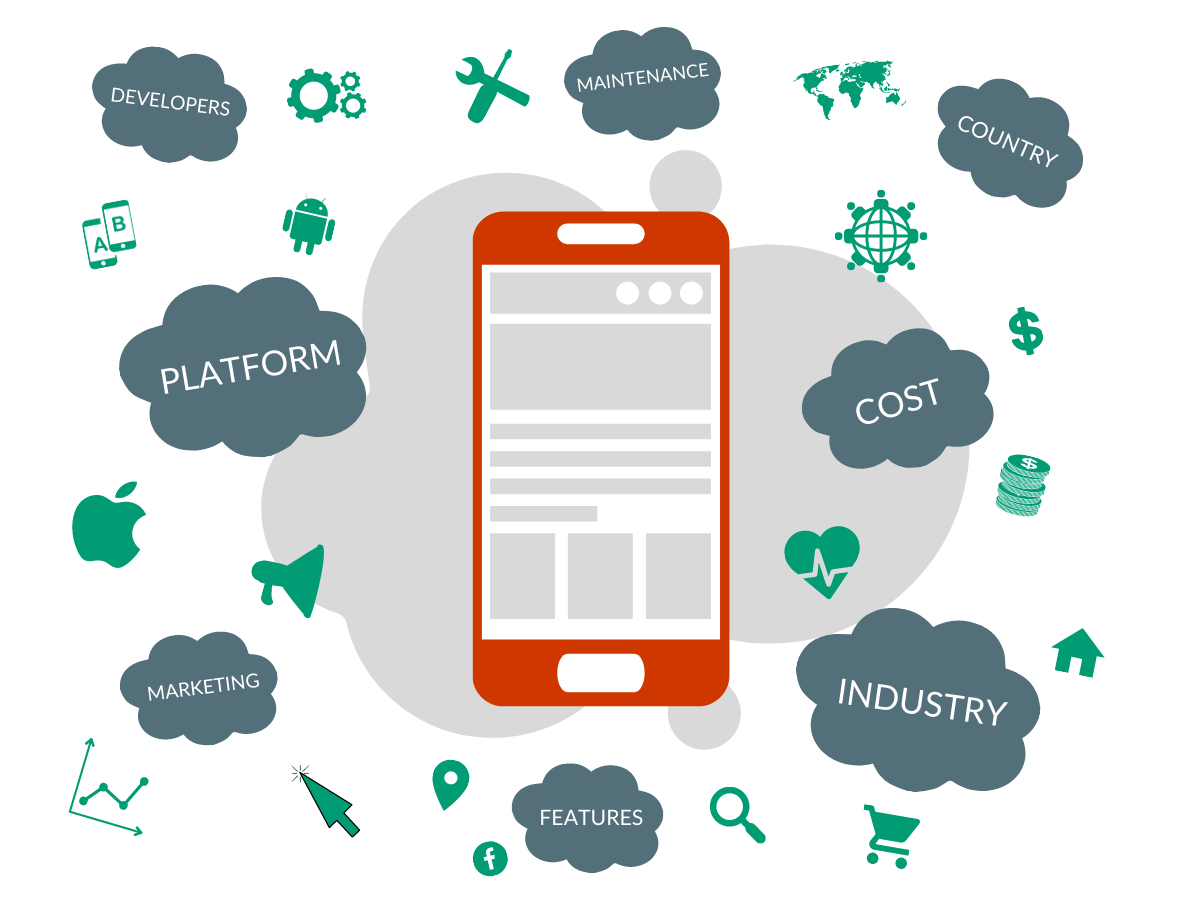
What all determines the cost of building an app

The total cost of building your app depends on MANY factors. Lets go over some of these.


Type of App

We will keep this one brief, since we mostly covered this topic, but the type of app you are aiming to build has a HUGE effect on how much you will be paying.


Complexity

How complex do you want your app to be? Is it a simple 2-3 screen app or a feature-rich application?


Design

If you are trying to build a simple utilities app for example, design won’t be a major cost for you. However, if you are trying to build a gaming app with powerful graphics, design will take up a large chunk of your total cost.


Vendor

Every software development firm has their own pricing range. It is good to get an estimate from at least 5-6 different firms before you make a deal. It is also important to keep in mind that there are other options such as freelance app developers, or you could even build your own app if you have the expertise to do so. All three of these options have different price levels.


Back-End Development

Almost all of the costs we talked about so far have to do with front-end app development, but you also have to include the costs for back-end development. You may ask “What is the difference between front-end and back-end?” Front-end is basically the app which the consumers will use, and all of its associated features. The back-end portion of the app is hosted on a remote server. Anything that happens in the back-end is not seen on the front-end app, and the back-end is used to carry out remote tasks that you don’t want your users to see, such as users’ vulnerable info or any other info stored in the app. Think of it like a restaurant. All the work happens in the kitchen, and only the final dish is seen by the customers. What happens in the kitchen affects the dish and the presentation of the dish.


Number of Platforms & Devices Supported

As for the number of platforms and devices you want your app to support, it is CRUCIAL to keep in mind that cross-platform and cross-device apps, also known as hybrid apps, are a lot cheaper as you don’t have to pay for additional costs in tailoring your app to each and every platform or device. We will go over this in more detail later in the guide.


Testing

Every app needs to be tested to make sure it runs properly. Testing costs anywhere from $5,000-$20,000 on average and again, it all comes down to your vendor and their average pricing.


Maintenance

App costs are not finished post-development. You have to take maintenance costs into account, which need to be paid every year. Maintenance costs are generally around 15-20% of the total development costs. Depending on the situation of your app, you will need different types of maintenance services and a certain amount of them as well.


Local Development or Outsource, which route to take?

There are pros and cons of both of them, but if you know what your app needs and what constraints you are working under, making this choice becomes more effortless.

If you opt to go for the outsourced route, then know that you will have access to a larger talent pool to choose from; you will get lower rates and much more flexibility. In addition to this, there are some cons with it as well such as communication problems which can be due to several reasons. One reason could be different time zones and it may get difficult at times to coordinate appropriately. Lastly, there is a lack of personal involvement, or as the saying goes, things may “get lost in translation.”

But, if you decide to go with local development, you get access to the developers, and you can meet them whenever you want as you will not be limited due to location. In addition to this, you can meet the team to communicate your ideas much more effectively. However, it can go against you if you are working on a tight budget because there may be little talent available, which may be expensive for you.


The Stages of App Development

Discovery Stage

The discovery stage is where all of the brainstorming happens. Ideas are conceptualized and goals as well as visions are communicated. Costs are calculated after taking everything into account.


Design Stage

The foundation for the UX/UI design of the app is laid out on this stage. This is a crucial stage for many apps, especially gaming and social media apps. The price range is quite broad as it depends on how complex or simple you want the design to be.


Development Stage

Your app is brought to life by the developer(s) and all features discussed in the Discovery Stage are implemented here.


Testing and Deployment Stage

An app is tested and deployed after the development stage to ensure that it runs smoothly on all platforms with no issues.


Maintenance

Wait! Just because your newly-developed app has passed the test and has been deployed does not mean it’s over. You have to remember the maintenance stage, which happens every year. Be ready to pay the fees to maintain your app and make sure it is updated every year.


How much time does it take to develop an app?

How long it takes to develop an app depends on a number of factors. How many platforms are you gunning for? What features are you trying to add to the app? The rough estimate of how much time is needed for an app to be fully developed is as follows:

  • A basic mobile app takes 400-700 hours
  • Apps that have advanced features can take up to 700-1000 hours
  • Highly complex apps that have technologies such as AI, ML, or VR development can take up to 1200 to 2000 hours.

It is worth keeping in mind that these times are just estimates, and in reality, the times can go up or down depending on how swiftly the development teams are working on your app.


A Breakdown of the Basic Features of Your App

Search Option

Help your app’s users navigate to where they want to quickly with a search feature.


Social Integration

On the topic of convenience, your app should be able to seamlessly connect with social platforms to ease the sign up process. An added benefit of social integration is that users can share any particular post or other info in the app to their social channels with the tap of a button, which gives your app more exposure.


Push Notifications

Almost every app needs a notifications feature as they are helpful for many, and it is the best way to remind users of something. Push notifications also increase app engagement as people are likely to revisit it after receiving one.


Customization/Personalization

When you collect user data after getting their permission, you can create a personalized user experience to satisfy their needs better. For example, if you have an eCommerce app, you can showcase similar products to the ones that they viewed previously, and it is likely to increase sales. If your app is very design-oriented, allowing your users to customize their dashboard or overall layout can make them really happy, and they will want to use your app more.


Offline Use

It is very convenient when users are able to use apps offline in places where the Internet may not be available, so this is a great option to consider.


Security

Nobody wants to use an app that will not protect their privacy and possible sensitive data. App security is not optional, and a good app will invest a good chunk of their cash into building secure features to make their users feel comfortable. It is also a good idea to have Single Sign-On (SSO) and Multi-Factor Authentication (MFA) options.


Feedback

Allow your users to give you feedback! This is the only way you will know what needs to be improved upon to provide a better user experience. Even a quick star rating option is better than nothing.


Add-On Features

These are features that will obviously bump up the price of building your mobile app should they be included, however, will also improve the quality of your app. Keep in mind that not all of these features will be required for your specific app, but you can decide which of these you choose to incorporate based on the function of your app.

Augmented Reality / Virtual Reality Integration

AR and VR mobile trends are on a rise, and will be more prominent in the coming apps. Although they are not required to make an award-winning app, it certainly scales your app to meet the growing demands of modern-day smartphone users.


Geolocation

Many apps need to be able to access a user’s location for them to use the app.


Ads Display

If your app will earn revenue through ads, you have to have this feature included.


Payments

If you are building an eCommerce app or any other app that requires transactions to be made through the app, you need to have a secure payment system enabled.


Chat

The chat feature is common in many social media applications, and is also a staple in telehealth applications where the patient may need to stay in touch with the doctor through the easiest contact method: text. These are just a few examples of many where a chat feature will be needed. Throw in a chatbot as well and this becomes one of the most valuable add-on features from our list.


Video Calls

Video (and audio) calls are a pricey feature to include, but the ROI is great if you are building a valuable app.


simple, medium, and complex apps features, time, cost etc.

Simple, Medium, and Complex Apps Features, Time, Cost etc.


Cross Platform App Functionality

A term you may hear quite often in mobile app development is cross-platform app functionality. Although this term may be overshadowed by its more popular opponent native apps, cross-platform apps or hybrid apps are underrated for a number of reasons.

First let us start off by saying that native apps are the go-to option for many simply because they are more reliable, and since they are specifically made for one operating system, all of the components of the native app are made to fit that one platform which results in faster loading speed.

However, if you choose to go with the native option, you will have to pay up for creating the same app for other platforms, which ends up being very pricey for some. But not to worry, if you cannot afford to pay double or triple the amount you will already be paying for your app, cross-platform app development is here to save the day.

Cross-platform apps have their own benefits including less development time, more cost-effective, more exposure etc. On the topic of speed, this is actually debateable. Some say there is not a significant difference between the speeds of native and cross-platform apps, but others get very annoyed by cross-platform apps.

This means you have three options: (a) develop one native app which has very fast speed, but sacrifice a good number of your audience reach (b) develop a cross-platform app that allows your app to be used by various devices and platforms, therefore giving your app more exposure, but sacrifice fast speed (c) develop multiple native apps, reaching a greater amount of people and providing them with a fast and high quality app, but sacrifice cost.


How much does app maintenance cost?

When users download an app, they expect regular updates to improve the app and ensure that the app is compatible with all the latest versions of the operating systems. In addition to this, there are often bugs in the app that require sorting out to ensure that the user experience is up and up.

When it comes to calculating how much it will cost to maintain your app, then a good rule of thumb would be to take the 20% of your app’s original development cost, and that will be the cost of maintenance.

When you maintain an app, you are not just paying for the cosmetic changes; you are also paying for the server costs, development costs, content costs, and other such features that ensure that your app is enjoyable in the longer run. Longevity is something that you need to go after because once you rack up those users, you want them to stay, and to do that, you need to give them constant updates.


App Marketing

You built an amazing app with your hard earned money, now what’s next? How is your app going to earn revenue? Marketing your app should be a task on your to-do list if you want your app to be successful. You should set aside a budget for app marketing before you even get your app developed. But how do you determine the cost of marketing your app? Well, it depends on which and how many avenues you decide to use to your advantage.

Here are some common ways people market their apps, and the average cost to use these methods.

App Store Optimization

If your app is not optimized to rank high in the app stores, you will lose A LOT of potential traffic. That is why we advise you to focus on App Store Optimization first. Here are some tips to optimize your app for the iOS App Store and the Android App Store. You can also use an App Store Optimization (ASO) tool which will cost you anywhere from $30-$1,000 dollars/mo.


PR Outreach

You want your app to show up in various publications with maximum exposure to your intended audience. Get ready to do a press release and reach out to several PR agencies. The average hourly cost for a PR agency can be anywhere between $100-$300.


Influencer Marketing

Use your influencers! Let them try out your app and they can introduce it to a whole network of potential users. Remember to go for influencers that have followers/subscribers of your target audience. The average cost for this can be around $100-$300 per influencer.


Social Media

First off, if you don’t create social media pages for your apps, what are you doing? Social media is one of the best ways to bring attention to your app. Along with company pages, you can also choose to do paid ads, which can cost as little as $20 to $1000/mo., depending on how long you want the ads to run and which platforms you choose.


Paid Ads

Lastly, you can choose to go the paid ads route as well with Google and Bing Ads. Similar to social media, you set the budget and the time you want the ads to run, so again, the price range is very broad. Paid ads can also cost you anywhere from $20-$1000/mo.

Keep in mind that your ROI will be a lot higher if you build a good app and market it 10x better.


Key Takeaways (TL;DR) 

Since we covered a boatload of vital info in this article, here is a quick summary of all the major points that we went over:

General

  • The average cost of developing an app is between $20,000 and $80,000
  • Every region of the world has their own price ranging with app development. You can pay as much as $150-$250/hr in the US and as low as $11-$70 in India and Pakistan. However, there are disadvantages to offshore development such as time zones, misinterpretation due to different cultures etc.
  • The formula to calculate app development cost is price/hr. X number of hours = total development cost


Types of Apps

  • How much you need to pay to develop an app depends on what type of app you want to bring to life. A gaming app may go up to a million bucks while a lifestyle app typically tops off at $50,000.
  • Some current app trends which are likely to grow are apps that involve Artificial Intelligence (AI), Augmented Reality (AR), Virtual Reality (VR), on-demand services etc.
  • Technologically speaking, there are three major types of apps: hybrid apps, web apps, and native apps. Native apps are the most popular since they are known for being fast in speed. However, a more cost-effective version is hybrid apps, which don’t require additional development hours to fit different platforms/devices. Web apps are accessed via the Internet and use programming languages such as HTML, CSS, and Javascript.


Determinant Factors

  • Type of app, from both a vertical and technological standpoint
  • Complexity
  • Design
  • Local or Outsourced
  • Vendor
  • Back-End Development
  • Number of platforms / devices
  • Testing
  • Maintenance
  • Complexity of Features
  • Level of App Marketing


Conclusion

We highly encourage you to use this comprehensive guide as one of your top app development cost resources when building your next-generation mobile app. Mobile app development is a complex process, but if strategically planned and carried out right, you are well on your way to becoming the next innovative entrepreneur with a powerful mobile application! Whether you want to build the next trend-setter app such as Uber, TikTok, or Instagram, or if you are looking to build a mobile app specifically for your business, whatever vertical it may be in, the most important part is choosing the right developer(s) who can handle your project.

Sunvera can build the perfect mobile app for your business while helping you reduce costs and improve operational efficiency. Contact us for a FREE 2-hour consultation.

5 Reasons Why Super Apps Are Attractive to Users

Super apps are a relatively new category of apps, which have been popping up exponentially in the last few years. Super apps are attractive to users because they combine a handful of services into one app. An example of super apps is Waze. Waze is a GPS-based app that provides turn-by-turn directions, but it also allows the user to report any accidents or police presence. When you combine all of these features into one app, you end up with an app that has immense potential to build a concrete user base.


The Hype Behind Super Apps: 5 Reasons Why Users Love Them

There has been a lot of talk about super apps in the past few years, and the hype has increased especially in the last few months. What are the reasons behind all this hype?

1. Users Can Access Services From One App

One reason why users like super apps are that they only need one application to perform different functions. For example, most people don’t want to download four or five different apps for Facebook, Twitter, YouTube, and Gmail. You can access all of these services in your Chrome browser. However, there are limitations to using Chrome on your mobile device for social media. When you want to post something or check up on certain accounts, it’s much easier to use the dedicated social media app that you have. Users like super apps because they can easily access many different services in one application, which saves time and storage space.

2. The Apps Have Been More Consistent

As the popularity of super apps has increased, these apps have also become more consistent and have an easy user interface. The developers behind each app are trying to sync all of the features within the application to make them work better together. Plus, many companies have put a lot more time and effort into making sure that their applications run smoothly even with all of these additional features.

3. Easy-to-Use Applications

Another reason why super apps are so popular is that they simplify everyday tasks. For example, instead of using three different applications on your phone, you can easily use Waze to check up on traffic conditions before leaving work. Swiping left will allow you to read reviews about specific places while clicking on the red pin will allow you to report accidents or police presence. Super apps are much easier than downloading multiple applications for different services that do roughly the same thing.

4. Cross-Platform Capabilities

Super apps are attractive because they can be accessed from whichever platform the user chooses. For example, if a user has a Windows laptop and an iPhone, he or she can download the Instagram app for both devices. Despite being on different platforms, both applications have relatively similar functions. If you want to post a picture on your timeline or check out what others have been posting, Instagram has you covered.

Similarly, if an individual wants to post something to his Twitter account while using his Android phone, it’s as simple as downloading the Twitter app and sharing away. That is one of the main advantages that super apps offer: cross-platform capabilities that allow users to access their information anywhere and at any time.

5. Better Customer Service

Many companies such as Amazon and Google offer 24/7 customer service through their applications, thus creating a better relationship with their customers. For example, by using the Google Maps app on your iPhone, you can easily check up on different routes to your local grocery store or maybe address any questions that you have about how to work it.

Super apps are attractive because they offer easier access to customer service reps for users who may have queries regarding services provided by companies. This also helps cut down costs of hiring call center employees.


What’s Next?

In a world of low connectivity, a new super app will save the day. In the future, we can expect super apps to keep evolving. Users who are interested in playing games on their mobile devices will find that single-purpose gaming apps will be replaced by more comprehensive ones such as Supercell’s Clash of Clans. This game not only allows gamers to battle others online but also enables them to upgrade buildings and equipment while waiting for train or bus stops. As these types of services continue to evolve, both users and companies will likely continue investing in super apps.


Sunvera Software develops next-level software applications from start-to-finish. We are a premier software and mobile app development agency specializing in healthcare mobile app development, custom mobile app development, telehealth software, sales dashboards, custom mobile app development services, retail software development, supply-chain software, ecommerce, Shopify, web design, iBeacon apps, security solutions and unified access software.

We are proud partners with Amazon AWS, Microsoft Azure and Google Cloud.

Schedule a free 30-minute call with us to discuss your business, or you can give us a call at (949) 284-6300.

 

These 3 Industries are Taking Advantage of Super Apps

According to Forbes, a super app is “a mobile application that offers various services through a single app”.

This is a different strategy from the traditional app development process in which a business would develop an app for each service it has to offer. With this type of approach, a firm will need to invest more time and money developing several apps for their services while having the risk of losing the customer’s interest if they download few or none at all.

Super app solutions allow businesses to consolidate their services into one platform that is accessible on the user’s mobile device, allowing them to save storage space, time, and money.

Industries Who Are Using Super Apps

The concept of super apps has become very attractive for consumers mainly because of the convenience factor. One super app usually covers a wide range of services without the hassle of downloading different apps for each service.

Companies are noticing the need for super apps and are starting to incorporate them into their businesses as well. Here are three industries that are taking advantage of the super app phenomenon:

1. The Telecommunication Industry

The telecommunications and Internet service provider industry started using the super app strategy with their apps, such as T-Mobile Tuesdays and Verizon’s Hum, both of which provide additional services to customers. Now, even more, telecom companies such as ATT are following suit with the launch of their super app called “ATT Connect”.

2. The Finance Industry

The financial institution industry is a great example of how transactional super apps can benefit businesses. TD Bank launched their mobile app called “T.D. Wallet,” which covers a wide range of financial services, including account monitoring, mobile deposits, and check cashing capabilities. Another bank that has taken advantage of super apps is Capital One, with their “Quicksilver” app that also covers a wide range of financial services, including offering cash rewards to cardmembers.

3. The Online Retail Industry

The need for convenience and speed is very important to consumers, and that is why companies like Amazon, eBay, and Walmart are turning into super apps as well. Launched in 2011, Amazon’s app can be used not only as a shopping tool but also as a way to manage your account, view items you have purchased online, and track your book lists.

eBay created their super app called “eBay Now” which allows users to order items online from local stores and have them delivered right to their doorstep through the app, while Walmart uses its super app called “Walmart Pay” which allows users to pay for their items without using cash.

Super apps have become a trend not only in the mobile app industry but also in various businesses because it is a cost-effective and time-efficient way to reach out to customers. This new development is revolutionizing the way consumers shop, travel, and bank, and there are many industries taking advantage of super apps.

This strategy can also benefit companies because it allows them to save resources and time by consolidating their resources into one platform. The future of super apps looks very promising because there are still many industries that have yet to take advantage of these technological advancements. With this new type of app, companies can stand out from their competition by providing an app that will benefit the customer and engage them in a lasting relationship.


Sunvera Software develops next-level software applications from start-to-finish. We are a premier software and mobile app development agency specializing in healthcare mobile app development, custom mobile app development, telehealth software, sales dashboards, custom mobile app development services, retail software development, supply-chain software, ecommerce, Shopify, web design, iBeacon apps, security solutions and unified access software.

We are proud partners with Amazon AWS, Microsoft Azure and Google Cloud.

Schedule a free 30-minute call with us to discuss your business, or you can give us a call at (949) 284-6300.

 

Ready to discuss your project? Contact Us